Politics
Monday, October 19, 2026
Politics · Analysis · Developments
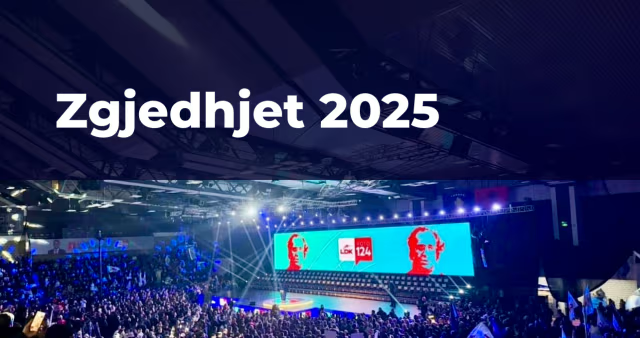
The election campaign for the parliamentary elections to be held on February 9th officially begins.
Political parties in Kosovo have launched their electoral activities with large rallies and messages addressed to citizens. The main parties have chosen different locations to officially open their campaigns. The Vetëvendosje Movement has launched its campaign from Gjakova, while the Democratic League of Kosovo has held its rally in Pristina. The Democratic Party of Kosovo has chosen the “1 Tetori” hall in the capital, while the AAK-Nisma coalition has launched its activities with tributes in Prekaz. Through rallies, speeches and meetings with citizens, the parties aim to mobilize supporters for an electoral race that is expected to be very dynamic and competitive.
Ad space

Trump: "We Need Greenland for National Security Purposes"
President-elect Donald Trump has revived his interest in buying Greenland, highlighting the island’s strategic importance with the statement “We Need Greenland for National Security Purposes.” Greenland is strategically located in the Arctic, making it a key point for global trade routes and military operations. The island is home to the U.S. Base Pituffik (formerly Thule Air Base), which is vital for missile defense and early warning systems. European leaders have reacted to Trump’s statements. On the other hand, Greenland’s Prime Minister, Múte Egede, has reiterated that the island is not for sale and is seeking to strengthen its independence from Denmark.
In this section

Politics
Grenell for Nacionale: The US had excellent relations with Rugova, Thaçi and Hoti for 35 years, only with Kurti are relations in crisis
Nacionale reports that Richard Grenell, the Trump administration’s Special Envoy for Special Operations, has exclusively stated to Nacionale that for the first time in 35 years, relations between Kosovo and the US are in crisis and politicized. “Ibrahim Rugova, Hashim Thaçi and Avdullah Hoti, all of whom had excellent relations with Republicans and Democrats in America. The only time in 35 years when Kosovo-US relations (and Kosovo-EU relations) became partisan and in crisis, is with Albin Kurti as prime minister,” Grenell told Nacionale.

Politics
The United States Congress officially certified Donald Trump's victory
On January 6, 2025, the United States Congress officially certified Donald Trump's victory in the 2024 presidential election. The certification process went smoothly, compared to the events of January 6, 2021. The session was chaired by Vice President Kamala Harris, who was the Democratic presidential candidate and was defeated by Trump. She emphasized the durability of American democracy and the importance of a peaceful transfer of power. The certification confirms that Donald Trump will take office on January 20, 2025, marking his second, non-consecutive, term as President of the United States.

Politics
Ranking of Political Parties on the Ballot Paper for the February 9 Elections
The Central Election Commission (CEC) has completed the drawing of lots to determine the ordinal numbers of political parties on the ballot for the February 9 elections. The ordinal numbers of the main parties are: 118: Vetëvendosje Movement 124: Democratic League of Kosovo (LDK) 131: Democratic Party of Kosovo (PDK) 137: Social Democratic Initiative - AAK, Intellectual Forum E-30, Conservative List These numbers will be used on the official ballot and will help voters identify the parties in the race.
More headlines

06
Faith in God in Abdixhiku's Journey
In a recent interview, the leader of the Democratic League of Kosovo (LDK), Lumir Abdixhiku, emphasized the importance of faith. This reflection has received attention, especially for the way he has incorporated faith into key moments of his life, including his academic work. A significant detail in this context is the inclusion of the phrase “In the name of God, the Merciful, the Merciful” in the dedication of his doctorate in July 2013 at Staffordshire University in the United Kingdom. This act reflects his gratitude to God and his family, as well as the spiritual values that have guided his journey so far.

07
Haradinaj Promises Capacities for the Production of Clean Hydrogen
Ramush Haradinaj has presented a plan to build capacities for the production of clean hydrogen, an energy source based on renewable sources such as wind and sun. According to him, hydrogen produced from wind and sun energy can serve as an effective solution for managing excess energy supplies. Electrolysis technology will enable the storage of energy in the form of hydrogen, which can then be used to balance energy flows, making the system more flexible and contributing to the reduction of carbon emissions. The proposed strategy involves significant investments, with approximate costs of 1-1.5 million euros per megawatt for electrolysis capacities and 50-100 million euros for the construction of infrastructure for the storage and transportation of hydrogen.

08
Battle for Prime Minister: Who will lead Kosovo after February 9?
Parliamentary elections are approaching, with four leaders vying for the post of Prime Minister and the leadership of Kosovo. Albin Kurti, the current Prime Minister of Kosovo and leader of the Vetëvendosje Movement, a party that emerged as a movement for self-determination and social reform. A graduate of the Faculty of Engineering at the University of Pristina, Kurti has been a figure in Kosovo politics since the time of the war for independence, when he distinguished himself as an activist and later as a political prisoner. Lumir Abdixhiku, leader of the Democratic League of Kosovo (LDK), a historic party in Kosovo politics. With a doctorate in economics from Staffordshire University in the United Kingdom, Abdixhiku has a strong academic background and experience in prestigious institutions. As a moderate and pragmatic voice, he is committed to modernizing the economy and encouraging foreign investment in Kosovo. Bedri Hamza, the candidate for Prime Minister from the Democratic Party of Kosovo (PDK), is an experienced economist and politician. As a former Minister of Finance, he is known for his careful management of fiscal policies and ensuring economic stability in challenging times for Kosovo. He currently serves as the Mayor of Mitrovica. Ramush Haradinaj, former Prime Minister of Kosovo and leader of the Alliance for the Future of Kosovo (AAK), is a strong political figure with a long history of national service. Known for his role as a commander of the KLA during the war for independence. Haradinaj studied at the Faculty of Law of the University of Pristina and holds a master’s degree from the American University in Kosovo. His political career has focused on national security, infrastructure development, and strengthening Kosovo’s sovereignty. These elections represent a critical moment for Kosovo, where citizens will evaluate competing visions for the country’s future, voting on February 9, 2025 in what is expected to be a very close race.

09
ECAP Approves Srpska List's Appeal for Certification in the 2025 Parliamentary Elections
The Electoral Complaints and Appeals Panel (ECAP) has approved the appeal of the political entity Lista Srpska, deciding that this political entity be certified for participation in the Kosovo parliamentary elections, which will be held on 9 February 2025. The decision was taken in a session held on 25 December 2024 by a panel composed of judges Arsim Hamzaj, Hajriz Hoti, Kujtim Pasuli, Hidajete Gashi Alaj and Bujar Muzaqi. The ECAP annulled the previous decision of the Central Election Commission (CEC) dated 23 December 2024, which had refused to certify Lista Srpska. The panel ordered the CEC to certify the entity and its candidates, based on the recommendations of the Office for Registration, Certification and Financial Control of Political Entities. According to the ECAP, Lista Srpska had submitted all necessary documentation within the legal deadlines through the CEC's online platform.

10
CEC: Serbian List Not Certified for February 9 Elections
The Central Election Commission (CEC) in Kosovo has decided not to certify the Serbian List, the largest Serb party in Kosovo, for participation in the February 9 parliamentary elections. This decision was made after the assessment of the Office for the Registration of Political Parties, which examines whether a political entity meets the legal criteria for participation in elections. The main justification for the refusal is related to the Serbian List’s connections with key figures in the Serbian government, including President Aleksandar Vučić and other individuals such as Milan Radoićić. CEC member Sami Kurteshi stated that “Representatives of this List maintain constant contact, they are seen in photographs and on television with Vučić’s government, but where Radoićić is also seen,” arguing that this is a sufficient reason not to certify the party.