Innovation
Monday, October 19, 2026
Technology · Analysis · Developments
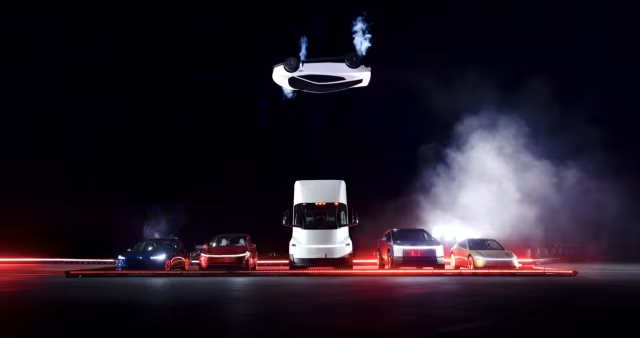
Tesla brings space technology to the asphalt: Roadster debuts with spectacular maneuvers
Tesla has unveiled the new generation of the electric sports car Roadster, demonstrating extraordinary technologies that enable the vehicle to move with its wheels up, lift into the air, and perform controlled maneuvers during flight.
The presentation took place on October 15 at SpaceX's testing center in McGregor, Texas, where Elon Musk and company executives demonstrated the capabilities of a vehicle that combines electric technology with propulsion systems inspired by the space industry.
During the demonstration, the Roadster climbed a sloped ramp, continued moving in an inverted position and then detached from the surface, rotating in the air before landing on its wheels.
In another demonstration, the car rose above a line of Tesla vehicles, including the Cybertruck, Cybercab, Semi, Model Y and Model 3, performing an aerial rotation maneuver.
Demonstrated Technologies
One of the main innovations is the fan system mounted under the vehicle's chassis, which creates low pressure and suction force, keeping the car attached to the surface.
According to Lars Moravy, Vice President of Engineering at Tesla, the system can generate a suction force up to twice the vehicle's weight, enabling movement even in an inverted position.
The technology also aims to improve acceleration, braking and cornering stability, increasing the force with which the tires press against the pavement.
The Roadster also uses compressed gas thrusters, developed with SpaceX technology. The system includes ten thrust nozzles, which enable the vehicle's lift and control of its orientation in the air.
During the presentation it was explained that the car has two tanks with a total capacity of 600 liters, holding about 250 kilograms of compressed air. Musk stated that the system can refill the tanks without the need for special rocket fuel.
In addition to the propulsion systems, Tesla showcased the Roadster's active aerodynamics, including a rear wing with adjustable angle and configurations that transition from low air resistance to high aerodynamic downforce.
The vehicle also features electronic steer-by-wire, electronic braking and acceleration control, as well as integrated suspension components in the chassis structure to reduce weight.
From 0 to 97 km/h in less than a second
Another demonstration was the Roadster's acceleration from 0 to 60 miles per hour, equivalent to about 97 kilometers per hour, in just 0.81 seconds, according to measurements presented by Tesla.
The company states that the car can reach a top speed of over 370 kilometers per hour, while the targeted range is over 480 kilometers on a single charge. These figures remain manufacturer claims and have not yet been independently verified.
Three Roadster versions
Tesla has unveiled three configurations of the new model.
The Performance version is designed for road use, with two suspensions, active aerodynamics and an under‑chassis suction system.
The Thrust version adds compressed gas thrusters to the rear, aiming for greater acceleration and track performance.
The Rocket version, which will be offered by invitation only, includes a more advanced thrust system for lift and aerial maneuvering. This configuration is designed with a single suspension and is not approved for public road use.
Production is expected to start in 2028
Despite the spectacular demonstrations, the Roadster is not yet in mass production. Musk has warned that production is expected to begin in 2028, after several project delays since its initial unveiling in 2017.
Tesla has already opened reservations for some configurations, but final pricing and concrete delivery timelines have not been confirmed.
Musk has also acknowledged that the Roadster's extreme capabilities are not necessarily optimized for safety and that some of them may not be permitted by road traffic regulations.
With this presentation, Tesla aims to position the Roadster not only as one of the fastest electric cars, but also as an experimental platform that merges automotive engineering with space technology.
Ad space

“It’s Moving Too Fast”: From Railways to AI, the Fear of Losing Control
Calls to slow down the development of artificial intelligence are often based on a simple concern: the technology is advancing too quickly, and humans may lose control over it.But this kind of concern is not new.Nearly two centuries ago, the development of railways brought a transformation that was just as unfamiliar to the society of its time. People were traveling at speeds they had never experienced before and were handing control of their movement over to a mechanical system they did not operate themselves.
“It’s Moving Too Fast”The speed of railways was one of the factors that created uncertainty during the early days of modern transportation. For a society accustomed to walking, horses, and carriages, traveling at high speeds was something entirely new.Today, an almost identical argument can be heard about artificial intelligence: development is moving so quickly that society, laws, and safety mechanisms may struggle to keep pace.The technologies are entirely different. The human reaction to the speed of change, however, bears similarities.
“We Don’t Have the Steering Wheel”A train passenger did not have a steering wheel and did not determine every movement of the vehicle. The passenger entrusted the journey to the locomotive, the tracks, the driver, and an infrastructure controlled by others.A similar form of concern is emerging today around artificial intelligence. AI systems can produce outputs and take steps that users do not individually determine, creating the impression that part of the control is being handed over to the machine.In both cases, the source of fear is not necessarily the technology itself, but the loss of the direct control that people had been accustomed to having.
“One Mistake Could Affect Many People”Industrial technology also changed the scale of accidents. A problem within a railway system could put many passengers at risk simultaneously.Artificial intelligence brings a modern version of this concern about scale. A digital system can be used by millions of people or integrated into many institutions at the same time. As a result, a single error can potentially multiply much faster than an individual human mistake.
“We Should Slow It Down Until We Understand It”Almost every transformative technology creates a period in which its capabilities develop faster than the rules surrounding it.Railways created the need for new safety standards, signaling systems, operating rules, and regulatory institutions.Artificial intelligence is now generating similar debates over licensing, testing, accountability, and the limits that should be placed on more advanced systems.The major difference is that part of the AI debate goes much further: from managing concrete risks to scenarios in which artificial intelligence could become uncontrollable.These scenarios remain far more uncertain than the risks that can already be observed.
“It Will Take Our Jobs”Previous technological transformations did not eliminate work, but restructured it. Railways and industrialization weakened some professions and business models, while capital, labor, and demand shifted toward new industries.In the near future, AI is expected to bring a similar restructuring of the labor market. Automation reduces the need for certain tasks, but at the same time increases productivity, lowers costs, and changes how work is organized. A job that once required ten people may be performed by a smaller team, while the labor and capital that are freed up shift toward new products, services, and economic activities.The economic impact of AI, therefore, should not be viewed solely in terms of replacing jobs, but as a restructuring of how the economy allocates labor, capital, and productivity.
Different Technologies, Same FearsThe comparison does not imply that artificial intelligence and railways pose the same risks.AI has capabilities that a locomotive never had: it can generate information, write software, analyze data, communicate, and potentially connect to other systems.Railways show that when a technology removes limits that have long been considered normal—limits of speed, scale, or human control—society’s initial reaction often includes fear.Some of these fears prove justified and ultimately lead to better safety standards. Others fade as the technology becomes commonplace and people learn how to control it.
In this section

Innovation
Meta dhe EssilorLuxottica sjellin syze të reja inteligjente
Meta dhe EssilorLuxottica kanë prezantuar një linjë të re syzesh inteligjente të pajisura me inteligjencë artificiale, duke synuar ta bëjnë teknologjinë më të përballueshme dhe më të integruar në jetën e përditshme të përdoruesve.
Modelet e reja nisin me çmim prej 299 dollarësh dhe vijnë në disa stile të ndryshme, përfshirë korniza drejtkëndëshe dhe modele ovale të zhvilluara në bashkëpunim me Kylie Jenner. Ndryshe nga gjeneratat e mëparshme, syzet e reja nuk mbajnë markat Ray-Ban apo Oakley, megjithëse prodhohen nga EssilorLuxottica.
Pajisjet përfshijnë kamera, mikrofonë dhe altoparlantë të integruar, duke u mundësuar përdoruesve të realizojnë foto dhe video, të kryejnë telefonata dhe të ndërveprojnë me asistentin Meta AI pa përdorimin e duarve. Inteligjenca artificiale mund të analizojë mjedisin përreth, të ndihmojë me navigimin, përkthimet në kohë reale dhe t’u përgjigjet pyetjeve bazuar në atë që sheh përdoruesi.
Sipas Meta-s, këto janë pajisjet e para që debutuan me modelin e ri të inteligjencës artificiale “Muse Spark”, të zhvilluar nga laboratorët e saj të avancuar të AI-së. Kompania e konsideron këtë hap si pjesë të vizionit për “inteligjencën personale”, ku AI-ja shoqëron përdoruesin gjatë gjithë ditës përmes pajisjeve të veshshme.
Lansimi vjen në një kohë kur konkurrenca në tregun e syzeve inteligjente po intensifikohet, me kompani të mëdha teknologjike si Apple, Google dhe Snap që po investojnë gjithashtu në produkte të ngjashme. Megjithatë, Meta mbetet lider i tregut global të syzeve inteligjente.