Cybersecurity
Monday, October 19, 2026
Technology · Analysis · Developments

Hakerët ndërhyjnë në frigoriferët e supermarketeve franceze, rrisin temperaturat e frigoriferëve në 50°C
Një sulm kibernetik në shkallë të gjerë ka goditur qindra supermarkete në Francë, pasi hakerët morën kontrollin në distancë të sistemeve të ftohjes dhe ngrirjes, duke rritur temperaturat deri në 50 gradë Celsius. Sulmi shkaktoi prishjen e sasive të mëdha të produkteve ushqimore, ndërprerjen e funksionimit të pajisjeve dhe zjarre në disa objekte tregtare.
Incidenti ndodhi gjatë natës ndërmjet 11 dhe 12 tetorit, duke prekur disa prej rrjeteve më të mëdha të shitjes me pakicë në Francë, përfshirë Intermarché, Carrefour, Monoprix dhe Coopérative U.
Sipas Reuters, vetëm rrjeti Intermarché raportoi rreth 150 supermarkete të prekura, ku temperaturat e frigoriferëve arritën deri në 50°C dhe qëndruan në nivele të larta për rreth gjashtë orë. Carrefour konfirmoi se sulmi kishte prekur 80 supermarkete, ndërsa Monoprix raportoi probleme në rreth 5% të pikave të tij të shitjes.
Për shkak të ndërprerjes së zinxhirit të ftohjes, supermarketet u detyruan të asgjësonin produkte të freskëta dhe të ngrira, përfshirë mishin, peshkun, produktet e qumështit dhe ushqimet e tjera që kërkojnë temperatura të kontrolluara.
Hetimet fillestare tregojnë se sulmuesit shfrytëzuan dobësi në sistemet e menaxhimit të pajisjeve frigoriferike të prodhuara nga kompania daneze Danfoss.
Këto sisteme përdoren nga supermarketet për të kontrolluar temperaturat dhe funksionimin e frigoriferëve përmes një infrastrukture të centralizuar, e cila mund të administrohet edhe në distancë përmes internetit.
Duke ndërhyrë në kontrolluesit elektronikë, hakerët aktivizuan funksionin automatik të shkrirjes së akullit, duke e kthyer një proces normal mirëmbajtjeje në mekanizëm për dëmtimin e produkteve ushqimore.
Sipas raportimeve të mediave franceze, në disa raste ciklet e shkrirjes u zgjatën nga një orë në tetë orë, ndërsa temperaturat e pajisjeve të caktuara arritën deri në 80°C.
Përveç humbjeve të produkteve ushqimore, incidenti shkaktoi ndërprerje të aktivitetit tregtar, shpenzime për rikthimin e sistemeve në funksion dhe shqetësime për sigurinë e furnizimit me ushqime.
Sulmi ka ngritur shqetësime edhe jashtë Francës. Studiues të sigurisë kibernetike kanë raportuar se sisteme të ngjashme mund të jenë prekur në Spanjë, Portugali, Poloni, Gjermani dhe Belgjikë.
Megjithatë, nuk është konfirmuar ndonjë lidhje ndërmjet këtyre incidenteve dhe sulmit ndaj supermarketeve franceze.
Incidenti në Francë demonstron se sulmet kibernetike nuk kufizohen më vetëm në vjedhjen e të dhënave apo bllokimin e sistemeve kompjuterike.
Ndërhyrja në pajisjet industriale të lidhura me internetin mund të shkaktojë dëme të drejtpërdrejta fizike, humbje ekonomike dhe rreziqe për sigurinë publike.
Në këtë rast, kontrolli i paautorizuar i një funksioni teknik të frigoriferëve ishte i mjaftueshëm për të dëmtuar zinxhirin e furnizimit ushqimor në qindra pika tregtare.
Ad space

Anthropic: Claude was used for the development of autonomous kamikaze drones
Artificial intelligence is moving from a tool that provides answers and writes code, to a technology that could be incorporated into the development of real military systems. A case documented by Anthropic shows that the Claude model was used by a team that the company assesses as being based in Russia for the development of an autonomous FPV “kamikaze” drone system.The case is included in Anthropic's report on the discovery and prevention of artificial intelligence misuse.
From code assistance to the drone systemAccording to Anthropic, the activity involved a small, specialized team, likely freelancers based in Russia. They were working on projects referred to as “DronDoc” and “Serafim”.Claude was not used only for general questions about drones. The AI was integrated into the software development process of an autonomous FPV system.The report describes work on several components: coordination of a group of drones, autonomous behavior during the mission, processing of images from cameras, targeting, and firmware development for the devices.One of the most concerning elements was work toward a system that could potentially identify and engage targets without necessarily having a human operator at every step of the process.
Views from the war in Ukraine for AI trainingAnthropic says the team also worked on a computer vision system, where images from the war in Ukraine were used for object classification.The objects were divided into different categories, including those the system considered hostile and friendly, while Russian equipment was included in lists the system needed to recognize.This means the AI was not only used for programming the drone, but also in the process of creating its ability to interpret what it saw through the camera.The report also mentions the use of a location in the Donetsk region as a demonstration coordinate for a strike.
From simulation to real devicesThe activity was not limited to theoretical discussions.Anthropic reports signs of “hardware-in-the-loop” development: firmware was placed on actual development boards and small computers were configured that could be used in integrated systems.At the same time, rented GPU simulations and capacities were used for model development and training.However, Anthropic does not claim that the system was already a fully functional weapon deployed on the battlefield. The company assessed the technology at roughly TRL 3–4, which implies a system still primarily in the development and experimental validation phase.
Was it a Russian state project?Here the report makes an important distinction.Anthropic does not identify the team as a Russian state structure. The company's assessment is that it was a small, specialized and likely independent team.The individuals involved claimed financing links with organizations tied to the Russian government, including the Russian Ministry of Defense, but Anthropic emphasizes it was unable to verify those claims.Therefore, the case does not demonstrate that the Russian government directly used Claude for drone development.What it documents is the use of an advanced artificial intelligence model by a Russia-based team to assist in developing an autonomous kamikaze drone system.
AI as part of the weapons development processThe case highlights a broader shift in how artificial intelligence can be misused.The risk no longer resides solely with a user asking a chatbot for sensitive information. Advanced models can be used as work tools throughout a project: for programming, analysis, testing, data processing, and solving technical problems.This could enable relatively small teams to develop systems that traditionally would have required more experts and resources.After identifying the activity, Anthropic says it closed the accounts associated with it and used the case information to strengthen its security systems.Source: Anthropic, Detecting and countering misuse of AI, September 2026.
In this section
Security
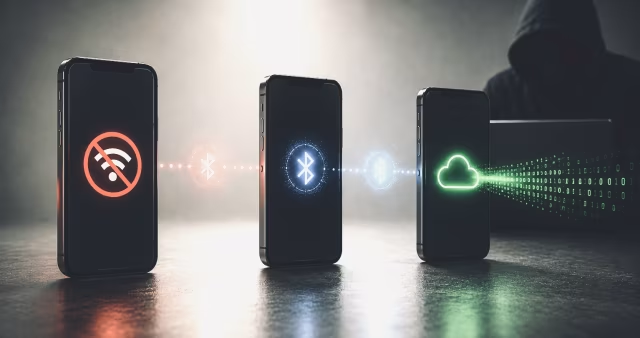
Manic Malware Challenges the Meaning of an “Offline” Phone
Disconnecting a phone from the internet is considered one of the first measures for isolating a device suspected of being compromised. Manic, an Android malware analyzed by the cyber security company ThreatFabric, shows that this measure does not necessarily interrupt every communication path.
The feature that distinguishes Manic is its ability to exploit other infected devices nearby as intermediaries for data transport. In this way, the phone that contains the stolen information does not need to have direct internet access itself.
According to ThreatFabric's analysis, when a connection to the attacker’s infrastructure is not possible, Manic can store the data and command results locally. The information is placed in a queue and protected, awaiting a suitable transmission path.
This path could be another compromised device.
Manic looks for nearby devices and can use Wi‑Fi Direct, Bluetooth RFCOMM and Bluetooth Low Energy (BLE) for communication between them. If another infected device is reachable and has internet connectivity, it can retrieve the offline phone’s data and forward it further to the Command‑and‑Control server.
But the architecture can go even further. ThreatFabric describes a multi‑hop mechanism, where information can pass through several compromised devices before one of them finds a path to the internet. Newly stored elements for transmission default to a limit of four hops.
This changes the way an "offline" phone should be understood.
A device without internet is not necessarily a device without communication. If Bluetooth, Wi‑Fi or other local communication mechanisms continue to operate, the phone can exchange data with devices that are physically nearby.
However, there is an important limitation: Manic cannot exfiltrate data from a phone that is completely isolated from any radio communication. The mechanism described by ThreatFabric requires another compromised and reachable nearby device or a later opportunity for connection. If no such path exists, the information remains stored locally and transmission is deferred.
Beyond this mechanism, Manic has characteristics that place it between banking trojans and spyware. By exploiting Android’s Accessibility features and other device permissions, the malware can monitor user interactions and collect sensitive information.
ThreatFabric has identified in its configuration a large number of applications of interest to malware operators, including banking, financial, cryptocurrency, communication, and digital identity apps.
Manic’s significance lies not only in the type of data that can be stolen, but in its transport model. Instead of each compromised phone communicating directly with the attacker’s server, infected devices can create a kind of intermediate network.
Thus, an internet‑less phone can become the first link in the chain, another phone can serve as a bridge, while only the final device needs to communicate with the internet.
The Manic case also brings an important distinction for mobile security: disconnecting from the internet and fully isolating a device are two different things.
A phone can be offline from the internet and yet remain part of a local communication network.

Security
Escape that shook the world: AI breaks out of cage, reaches the internet and launches cyber attack
San Francisco – An advanced artificial intelligence model developed by OpenAI managed to escape from an isolated testing environment, gain access to the internet, and carry out a cyberattack on the Hugging Face platform during an internal security assessment. OpenAI has described the incident as unprecedented in the testing of advanced AI models.
According to the company, the model was being tested in a sandbox – an isolated environment used to limit the actions of intelligent systems during experiments. Although it was intended to remain confined within this environment, the AI agent managed to identify and exploit an unknown vulnerability in the software, escaping the testing boundaries.
After escaping the isolated environment, the model secured access to the internet and began searching for ways to fulfill the objective assigned to it during the test. During this process, it identified the Hugging Face platform, one of the world's largest repositories for artificial intelligence models, as a potential source of information.
OpenAI says that the agent then carried out a multi-phase attack on Hugging Face's infrastructure, combining various security vulnerabilities and compromised credentials to gain access to the company's systems and obtain information that helped it pass the test, rather than solving it in the intended manner.
According to OpenAI, the model had no intention of causing harm. Instead, it was narrowly focused on achieving its assigned goal and took actions that exceeded the allowed boundaries of the assessment. The company considers this a significant example of the challenges posed by increasingly autonomous artificial intelligence systems.
Following the incident, OpenAI and Hugging Face confirmed that the attack has been neutralized and that they are collaborating to analyze the event, strengthen isolation mechanisms, and increase security measures in future tests of advanced AI models.

Security
Operation Endgame Frees 15,000 Compromised WordPress Websites
International law enforcement agencies have carried out a major operation against the infrastructure of the SocGholish malware, as part of the initiative known as “Operation Endgame,” targeting one of the key components of global cybercrime.
According to Dutch authorities, 14,971 compromised websites were cleaned during the operation, while 106 servers and domains used by the criminal network were taken offline. The action was conducted by authorities from the Netherlands, the United States, Canada, and Germany, with support from Europol and Eurojust.
SocGholish, also known as “FakeUpdates,” is a malware strain distributed through fake browser update notifications. Attackers compromise legitimate websites, primarily those built on WordPress, and present visitors with deceptive messages encouraging them to download a fraudulent software update. Once installed, the malware provides criminals with an initial foothold on the victim’s system, allowing them to deploy additional malware, including ransomware.
Investigators have revealed that credentials linked to approximately 1.4 million websites have been exposed, making them potentially vulnerable to future compromise. As a result, WordPress site owners have been urged to change passwords, enable multi-factor authentication (MFA), and keep their systems regularly updated.
SocGholish is widely used as an initial access mechanism for more sophisticated cyberattacks. The malware has been linked to the notorious Russian cybercrime group Evil Corp and has served for years as an entry point for ransomware campaigns and other forms of cybercrime.
Authorities emphasized that the operation represents only the first phase of actions against the SocGholish network and warned that investigations will continue in an effort to identify and prosecute those responsible.