Economy
Monday, October 19, 2026
Trade · Policy · Development

Nobel in Economics awarded to two economists who revolutionized economic stability theories
American economists Robert E. Hall and Michael Woodford have been awarded the Nobel Prize in Economic Sciences 2026, for their contribution to the development of theories that explain how individual decisions, expectations, and monetary policies affect economic stability.
The Royal Swedish Academy of Sciences has awarded the prize to the two economists for research on the microeconomic foundations of macroeconomic stabilization, a field that links the behavior of individuals and firms to overall economic developments.
Their studies have influenced how economists analyze consumption, savings, unemployment, inflation, and interest rates, helping develop the models used for designing and evaluating economic policies.
Robert E. Hall: Consumption, Savings, and Unemployment
Robert E. Hall, professor emeritus at Stanford University, is known for his contributions to consumption theory and labor market analysis.
One of his most important contributions relates to how individuals decide to consume or save.
Hall argued that, under certain theoretical conditions, changes in consumption depend primarily on new information that alters expectations about lifetime income, rather than simply on changes in current income.
This approach challenged the simpler models that linked consumption directly to current income.
Hall has also made important contributions to the study of unemployment, analyzing the mechanisms that affect job creation and the duration of unemployment during economic cycles.
Michael Woodford: Inflation and Monetary Policy
Michael Woodford, professor at Columbia University, is considered one of the most influential economists in the development of modern monetary policy theory.
His work focuses on how central banks can influence inflation and economic activity through interest rates and market expectations.
Woodford helped develop the well-known New Keynesian models, which combine the decision-making of individuals and firms with the presence of prices that do not adjust immediately to economic changes.
One of the main conclusions of this approach is that monetary policy affects the economy not only through the current decisions of central banks, but also through expectations about future decisions.
This has influenced the development of modern central bank communication strategies, which aim to guide market expectations regarding inflation and interest rates.
From Keynes to modern theories: How did the understanding of economics change?
To understand the significance of Hall's and Woodford's contributions, it is necessary to compare them with the economic theories that dominated the 20th century.
In the 1930s, British economist John Maynard Keynes argued that economies could remain for long periods in a state of unemployment and low economic activity due to a lack of aggregate demand.
According to the Keynesian approach, government intervention through public spending and fiscal policies could help restore economic activity.
This theory fundamentally changed economic thinking, challenging the view that market mechanisms would necessarily and quickly restore the economy to full employment.
However, early Keynesian macroeconomic models often relied on statistical relationships between economic indicators, without fully explaining the individual decisions underlying them.
In the 1950s and 1960s, Milton Friedman and other monetist economists emphasized the role of the monetary supply in determining inflation and economic activity.
Friedman argued that persistent inflation is fundamentally linked to an excessive increase in the money supply relative to output.
He also challenged the idea that governments could permanently maintain lower unemployment by tolerating higher inflation.
Another important development came in the 1970s, when Robert Lucas and other economists developed the theory of rational expectations.
According to this approach, individuals and businesses form expectations not merely by repeating past experiences, but by using available information to forecast future developments.
Lucas argued that historical relationships between economic indicators can change when government policies change, because individuals adjust their behavior.
This critique spurred the development of macroeconomic models based on individual decision-making.
What did Hall and Woodford bring differently?
Hall's and Woodford's contributions represent two important developments within this transformation of economic thought.
Hall helped explain consumption and the labor market by relying on individual decision-making and expectations about the future.
Woodford, meanwhile, developed a theoretical framework that combines elements of Keynesian economics with rational expectations and microeconomic foundations.
The main difference between the approaches lies in how they explain the economy's response to public policies.
While classical economics, represented by Adam Smith and David Ricardo, emphasized market mechanisms, competition, and the role of prices, Keynes shifted attention to aggregate demand and the need for state intervention during crises.
Friedman gave priority to the role of monetary policy and inflation control, whereas Lucas emphasized that individuals' expectations can alter the effects of economic policies.
Hall further developed consumption analysis, highlighting the importance of new information and expectations about future income. Woodford, on the other hand, combines Keynesian elements with rational expectations, explaining how central banks can influence the economy through interest rates and the communication of their policies.
Although these theories differ in their assumptions and conclusions, the development of economic thought does not represent a complete replacement of one theory by another.
Modern models have incorporated elements from several economic schools, while many of their conclusions continue to be debated and tested using empirical data.
From theory to practice: How do these studies affect today's economy?
The importance of these contributions becomes especially evident during periods of high inflation or economic slowdown.
According to the simplest traditional models, a central bank can affect the economy by changing the interest rate, which then influences lending, consumption, and investment.
The models developed by Woodford also place special importance on how individuals and firms interpret central bank decisions.
For example, if a central bank signals that interest rates will remain high for an extended period, this can affect credit and investment decisions even before future rate changes.
Similarly, Hall's studies help explain why a temporary increase in income does not necessarily translate into an equivalent increase in consumption.
If families view the income increase as temporary, they may choose to save a considerable portion of it.
These mechanisms are important for assessing the effectiveness of fiscal and monetary policies.
However, the actual responses of consumers and firms also depend on other factors, including uncertainty, credit constraints, and market conditions.
Nobel Prize in Economics
The Prize in Economic Sciences in Memory of Alfred Nobel was established in 1968 by the Central Bank of Sweden and was first awarded in 1969.
Unlike the five original Nobel Prizes, it was not part of Alfred Nobel's will, but is administered under similar principles.
The prize recognizes scientific contributions that have changed the understanding of economic processes, including economic theory, statistical methods, and empirical research.
Hall's and Woodford's contributions illustrate the development of modern macroeconomics toward a deeper understanding of the relationship between individual decisions, expectations, and economic policies.
The Royal Swedish Academy of Sciences has awarded the prize to the two economists for research on the microeconomic foundations of macroeconomic stabilization, a field that links the behavior of individuals and firms to overall economic developments.
Their studies have influenced how economists analyze consumption, savings, unemployment, inflation, and interest rates, helping develop the models used for designing and evaluating economic policies.
Robert E. Hall: Consumption, Savings, and Unemployment
Robert E. Hall, professor emeritus at Stanford University, is known for his contributions to consumption theory and labor market analysis.
One of his most important contributions relates to how individuals decide to consume or save.
Hall argued that, under certain theoretical conditions, changes in consumption depend primarily on new information that alters expectations about lifetime income, rather than simply on changes in current income.
This approach challenged the simpler models that linked consumption directly to current income.
Hall has also made important contributions to the study of unemployment, analyzing the mechanisms that affect job creation and the duration of unemployment during economic cycles.
Michael Woodford: Inflation and Monetary Policy
Michael Woodford, professor at Columbia University, is considered one of the most influential economists in the development of modern monetary policy theory.
His work focuses on how central banks can influence inflation and economic activity through interest rates and market expectations.
Woodford helped develop the well-known New Keynesian models, which combine the decision-making of individuals and firms with the presence of prices that do not adjust immediately to economic changes.
One of the main conclusions of this approach is that monetary policy affects the economy not only through the current decisions of central banks, but also through expectations about future decisions.
This has influenced the development of modern central bank communication strategies, which aim to guide market expectations regarding inflation and interest rates.
From Keynes to modern theories: How did the understanding of economics change?
To understand the significance of Hall's and Woodford's contributions, it is necessary to compare them with the economic theories that dominated the 20th century.
In the 1930s, British economist John Maynard Keynes argued that economies could remain for long periods in a state of unemployment and low economic activity due to a lack of aggregate demand.
According to the Keynesian approach, government intervention through public spending and fiscal policies could help restore economic activity.
This theory fundamentally changed economic thinking, challenging the view that market mechanisms would necessarily and quickly restore the economy to full employment.
However, early Keynesian macroeconomic models often relied on statistical relationships between economic indicators, without fully explaining the individual decisions underlying them.
In the 1950s and 1960s, Milton Friedman and other monetist economists emphasized the role of the monetary supply in determining inflation and economic activity.
Friedman argued that persistent inflation is fundamentally linked to an excessive increase in the money supply relative to output.
He also challenged the idea that governments could permanently maintain lower unemployment by tolerating higher inflation.
Another important development came in the 1970s, when Robert Lucas and other economists developed the theory of rational expectations.
According to this approach, individuals and businesses form expectations not merely by repeating past experiences, but by using available information to forecast future developments.
Lucas argued that historical relationships between economic indicators can change when government policies change, because individuals adjust their behavior.
This critique spurred the development of macroeconomic models based on individual decision-making.
What did Hall and Woodford bring differently?
Hall's and Woodford's contributions represent two important developments within this transformation of economic thought.
Hall helped explain consumption and the labor market by relying on individual decision-making and expectations about the future.
Woodford, meanwhile, developed a theoretical framework that combines elements of Keynesian economics with rational expectations and microeconomic foundations.
The main difference between the approaches lies in how they explain the economy's response to public policies.
While classical economics, represented by Adam Smith and David Ricardo, emphasized market mechanisms, competition, and the role of prices, Keynes shifted attention to aggregate demand and the need for state intervention during crises.
Friedman gave priority to the role of monetary policy and inflation control, whereas Lucas emphasized that individuals' expectations can alter the effects of economic policies.
Hall further developed consumption analysis, highlighting the importance of new information and expectations about future income. Woodford, on the other hand, combines Keynesian elements with rational expectations, explaining how central banks can influence the economy through interest rates and the communication of their policies.
Although these theories differ in their assumptions and conclusions, the development of economic thought does not represent a complete replacement of one theory by another.
Modern models have incorporated elements from several economic schools, while many of their conclusions continue to be debated and tested using empirical data.
From theory to practice: How do these studies affect today's economy?
The importance of these contributions becomes especially evident during periods of high inflation or economic slowdown.
According to the simplest traditional models, a central bank can affect the economy by changing the interest rate, which then influences lending, consumption, and investment.
The models developed by Woodford also place special importance on how individuals and firms interpret central bank decisions.
For example, if a central bank signals that interest rates will remain high for an extended period, this can affect credit and investment decisions even before future rate changes.
Similarly, Hall's studies help explain why a temporary increase in income does not necessarily translate into an equivalent increase in consumption.
If families view the income increase as temporary, they may choose to save a considerable portion of it.
These mechanisms are important for assessing the effectiveness of fiscal and monetary policies.
However, the actual responses of consumers and firms also depend on other factors, including uncertainty, credit constraints, and market conditions.
Nobel Prize in Economics
The Prize in Economic Sciences in Memory of Alfred Nobel was established in 1968 by the Central Bank of Sweden and was first awarded in 1969.
Unlike the five original Nobel Prizes, it was not part of Alfred Nobel's will, but is administered under similar principles.
The prize recognizes scientific contributions that have changed the understanding of economic processes, including economic theory, statistical methods, and empirical research.
Hall's and Woodford's contributions illustrate the development of modern macroeconomics toward a deeper understanding of the relationship between individual decisions, expectations, and economic policies.
Ad space

When Energy Is No Longer Just Energy
An analysis published by Arian Zeka has brought Kosovo’s energy security and the need for deeper strategic cooperation with the United States in the energy sector back into the center of public debate.
In the article titled “When Energy Is No Longer Just Energy: Why Kosovo Needs U.S. LNG,” Zeka argues that energy can no longer be viewed merely as a matter of supply or pricing, but rather as a crucial element of national security, geopolitical orientation, and the economic resilience of the state.
According to him, Kosovo should position itself more clearly within Europe’s ongoing energy transformation by building stronger ties with the American liquefied natural gas (LNG) market. In the analysis, U.S. LNG is presented not only as an energy alternative, but also as a strategic instrument for strengthening Kosovo’s energy and economic independence.
The debate comes at a time when many European countries are reassessing their energy policies following the crises of recent years and the geopolitical consequences of the war in Ukraine. Diversifying energy sources and reducing dependence on unreliable suppliers have become key components of security strategies across the continent.
Kosovo remains largely dependent on coal-based power plants, while its energy infrastructure often faces challenges related to sustainability and production capacity. For this reason, energy diversification is increasingly being viewed as a strategic priority for the country’s long-term economic development.
In his argument, Zeka also links energy to the broader dimension of Kosovo–U.S. economic relations, emphasizing the importance of transatlantic partnerships and the expansion of economic cooperation with American companies.
The discussion surrounding U.S. LNG also comes at a time when the Western Balkans region is exploring new infrastructure projects and alternative energy supply routes in an effort to strengthen future energy security and stability.
In the article titled “When Energy Is No Longer Just Energy: Why Kosovo Needs U.S. LNG,” Zeka argues that energy can no longer be viewed merely as a matter of supply or pricing, but rather as a crucial element of national security, geopolitical orientation, and the economic resilience of the state.
According to him, Kosovo should position itself more clearly within Europe’s ongoing energy transformation by building stronger ties with the American liquefied natural gas (LNG) market. In the analysis, U.S. LNG is presented not only as an energy alternative, but also as a strategic instrument for strengthening Kosovo’s energy and economic independence.
The debate comes at a time when many European countries are reassessing their energy policies following the crises of recent years and the geopolitical consequences of the war in Ukraine. Diversifying energy sources and reducing dependence on unreliable suppliers have become key components of security strategies across the continent.
Kosovo remains largely dependent on coal-based power plants, while its energy infrastructure often faces challenges related to sustainability and production capacity. For this reason, energy diversification is increasingly being viewed as a strategic priority for the country’s long-term economic development.
In his argument, Zeka also links energy to the broader dimension of Kosovo–U.S. economic relations, emphasizing the importance of transatlantic partnerships and the expansion of economic cooperation with American companies.
The discussion surrounding U.S. LNG also comes at a time when the Western Balkans region is exploring new infrastructure projects and alternative energy supply routes in an effort to strengthen future energy security and stability.
In this section

Economy
Financial markets rebounded sharply, while oil prices declined significantly following an agreement on a two-week ceasefire between the United States and Iran
Financial markets rebounded sharply, while oil prices declined significantly following an agreement on a two-week ceasefire between the United States and Iran. Oil prices fell by around 15–20%, while major indices, including the S&P 500, rose strongly, marking one of the best performances in recent months.
The reaction in financial markets came immediately after the news, which is seen as a step toward easing tensions in the Middle East. Investors, who had been concerned for weeks about the risk of a broader conflict that could disrupt global energy supplies, responded with optimism, pushing stocks higher and driving oil prices lower.
A key element in this development is the potential reopening of the Strait of Hormuz, one of the most important corridors for global oil transport. Any signal of stabilization in this area reduces pressure on energy markets and helps ease fears of rising inflation.
The decline in oil prices is also viewed as a positive factor for the global economy, as it can lower costs for businesses and consumers, increasing the likelihood of more accommodative monetary policies from central banks. This has contributed to a “risk-on” environment in markets, where investors are returning to riskier assets such as equities, particularly in the technology and transportation sectors.
However, analysts warn that this optimism may be fragile. The agreement is temporary, and many key issues remain unresolved, including Iran’s nuclear program and broader regional tensions. Any deterioration in the situation could quickly bring uncertainty back to markets.
For now, however, global markets are reflecting a clear sense of relief, marking one of the strongest positive reactions in recent months.
The reaction in financial markets came immediately after the news, which is seen as a step toward easing tensions in the Middle East. Investors, who had been concerned for weeks about the risk of a broader conflict that could disrupt global energy supplies, responded with optimism, pushing stocks higher and driving oil prices lower.
A key element in this development is the potential reopening of the Strait of Hormuz, one of the most important corridors for global oil transport. Any signal of stabilization in this area reduces pressure on energy markets and helps ease fears of rising inflation.
The decline in oil prices is also viewed as a positive factor for the global economy, as it can lower costs for businesses and consumers, increasing the likelihood of more accommodative monetary policies from central banks. This has contributed to a “risk-on” environment in markets, where investors are returning to riskier assets such as equities, particularly in the technology and transportation sectors.
However, analysts warn that this optimism may be fragile. The agreement is temporary, and many key issues remain unresolved, including Iran’s nuclear program and broader regional tensions. Any deterioration in the situation could quickly bring uncertainty back to markets.
For now, however, global markets are reflecting a clear sense of relief, marking one of the strongest positive reactions in recent months.

Economy
Banks Must Repay Phishing Losses as EU Opinion Strengthens Consumer Safeguards
An adviser to the Court of Justice of the European Union (CJEU) has stated that banks must immediately refund customers for unauthorized transactions, even when the customer may have acted with gross negligence. The opinion comes in a case involving a phishing fraud against a customer of a Polish bank.
The case arose after a bank client was deceived by a fraudster posing as a buyer on an online sales platform. The scammer sent a fake link imitating the bank’s website, prompting the customer to enter her login details. Using those credentials, the fraudster carried out an unauthorized payment from the victim’s bank account.
The customer reported the fraudulent transaction to her bank the following day. However, the bank refused to reimburse the money, arguing that the client had been grossly negligent by revealing her security details. The dispute was then brought before a national court in Poland, which asked the CJEU to clarify how EU law applies in such situations.
In his opinion, Advocate General Athanasios Rantos concluded that EU payment services law requires banks to refund unauthorized transactions immediately, unless there is a justified suspicion of fraud by the customer that must be reported to national authorities. According to the Advocate General, the legislation leaves no room for banks or member states to refuse reimbursement at the initial stage on the basis of customer negligence.
However, the opinion also notes that the refund does not necessarily end the matter. If a bank later proves that the customer deliberately or through gross negligence failed to protect their security data, the bank may seek to recover the amount from the customer. If the customer refuses to repay it, the bank would need to pursue the claim through legal proceedings.
The Advocate General emphasized that this interpretation aligns with EU legislation aimed at ensuring a high level of consumer protection in payment services across the European Union.
The opinion is not binding on the Court of Justice but often influences its final ruling. Judges of the Court will now deliberate before delivering a judgment at a later date.
The case arose after a bank client was deceived by a fraudster posing as a buyer on an online sales platform. The scammer sent a fake link imitating the bank’s website, prompting the customer to enter her login details. Using those credentials, the fraudster carried out an unauthorized payment from the victim’s bank account.
The customer reported the fraudulent transaction to her bank the following day. However, the bank refused to reimburse the money, arguing that the client had been grossly negligent by revealing her security details. The dispute was then brought before a national court in Poland, which asked the CJEU to clarify how EU law applies in such situations.
In his opinion, Advocate General Athanasios Rantos concluded that EU payment services law requires banks to refund unauthorized transactions immediately, unless there is a justified suspicion of fraud by the customer that must be reported to national authorities. According to the Advocate General, the legislation leaves no room for banks or member states to refuse reimbursement at the initial stage on the basis of customer negligence.
However, the opinion also notes that the refund does not necessarily end the matter. If a bank later proves that the customer deliberately or through gross negligence failed to protect their security data, the bank may seek to recover the amount from the customer. If the customer refuses to repay it, the bank would need to pursue the claim through legal proceedings.
The Advocate General emphasized that this interpretation aligns with EU legislation aimed at ensuring a high level of consumer protection in payment services across the European Union.
The opinion is not binding on the Court of Justice but often influences its final ruling. Judges of the Court will now deliberate before delivering a judgment at a later date.

Economy
Artificial Intelligence Risks Deepening Global Inequality Without Urgent Investment
Artificial intelligence (AI) is developing at an incredible speed and has the potential to transform economies, labor markets and public services around the world. However, without deliberate investment in infrastructure and digital skills, the benefits of AI risk remaining concentrated in rich countries, warns the World Bank in its latest Digital Progress and Trends Report 2025.
The report notes that the vast majority of innovation, capital and technological capacity in the field of AI is concentrated in high-income countries, while low- and middle-income countries face a lack of infrastructure, skills and access to technology.
“AI does not automatically bring development,” the report emphasizes. “Its impact depends on building the digital foundations that enable its adoption and adaptation.”
According to the World Bank, high-income countries own about 90 percent of the leading AI models, startups and venture capital investments, despite representing only a fraction of the global population. In contrast, many developing countries still have limited access to fast internet, reliable energy and cloud services.
Although generative artificial intelligence tools, such as ChatGPT, have rapidly spread globally, their use remains highly uneven. In rich countries, about a quarter of internet users have used these tools, while in low-income countries the percentage remains below 1 percent.
The report identifies a promising trend: the rise of what the World Bank calls “micro AI” – simple, affordable applications designed for common devices such as smartphones.
These solutions are already being used in key sectors such as education, health and agriculture. Teachers, nurses and farmers in countries such as India, Nigeria, Egypt and the Philippines are using AI as a “collaborator” that increases work efficiency, without replacing the human role. The World Bank emphasizes that to truly benefit from artificial intelligence, governments must invest in four fundamental pillars, known as the “4Cs”: Connectivity – affordable internet, sustainable energy and digital devices Compute – servers, data centres and cloud services Context – local data and content, in national languages and realities Competency – digital knowledge and skills to use AI Without these foundations, the report warns, AI adoption will remain limited and unequal.
Impact on the labor market
The report notes that demand for AI-related skills is growing faster in middle-income countries than in rich countries. However, a lack of quality training programs and brain drain are limiting the long-term potential.
At the same time, artificial intelligence can automate routine tasks and put pressure on wages, especially in service and administrative professions, increasing the risk of labor market polarization.
The World Bank calls on governments to act quickly and strategically, tailoring investments in AI to each country's level of readiness. Priorities should include expanding the internet, securing computing capacity, reforming education, and policies for the responsible use of artificial intelligence.
“AI represents a defining moment for global development,” the report says. “With the right policies, it can create inclusive growth. Without them, it risks becoming a new source of inequality.”
The report notes that the vast majority of innovation, capital and technological capacity in the field of AI is concentrated in high-income countries, while low- and middle-income countries face a lack of infrastructure, skills and access to technology.
“AI does not automatically bring development,” the report emphasizes. “Its impact depends on building the digital foundations that enable its adoption and adaptation.”
According to the World Bank, high-income countries own about 90 percent of the leading AI models, startups and venture capital investments, despite representing only a fraction of the global population. In contrast, many developing countries still have limited access to fast internet, reliable energy and cloud services.
Although generative artificial intelligence tools, such as ChatGPT, have rapidly spread globally, their use remains highly uneven. In rich countries, about a quarter of internet users have used these tools, while in low-income countries the percentage remains below 1 percent.
The report identifies a promising trend: the rise of what the World Bank calls “micro AI” – simple, affordable applications designed for common devices such as smartphones.
These solutions are already being used in key sectors such as education, health and agriculture. Teachers, nurses and farmers in countries such as India, Nigeria, Egypt and the Philippines are using AI as a “collaborator” that increases work efficiency, without replacing the human role. The World Bank emphasizes that to truly benefit from artificial intelligence, governments must invest in four fundamental pillars, known as the “4Cs”: Connectivity – affordable internet, sustainable energy and digital devices Compute – servers, data centres and cloud services Context – local data and content, in national languages and realities Competency – digital knowledge and skills to use AI Without these foundations, the report warns, AI adoption will remain limited and unequal.
Impact on the labor market
The report notes that demand for AI-related skills is growing faster in middle-income countries than in rich countries. However, a lack of quality training programs and brain drain are limiting the long-term potential.
At the same time, artificial intelligence can automate routine tasks and put pressure on wages, especially in service and administrative professions, increasing the risk of labor market polarization.
The World Bank calls on governments to act quickly and strategically, tailoring investments in AI to each country's level of readiness. Priorities should include expanding the internet, securing computing capacity, reforming education, and policies for the responsible use of artificial intelligence.
“AI represents a defining moment for global development,” the report says. “With the right policies, it can create inclusive growth. Without them, it risks becoming a new source of inequality.”
More headlines

06
Bitcoin in Free Fall
Bitcoin, the largest cryptocurrency and the symbol of the cryptocurrency market, has entered a period of decline, losing a significant part of its value in a short time. Over the past week, its price has fallen by about 9%, while from the historical peak of over $ 126,000 reached in early October 2025, it has currently fallen by more than 25%, stabilizing around the value of $ 95,000.
This sudden and rapid development has caused panic among many investors, especially short-term and speculative ones. The price drop has been driven by a combination of economic, technical and psychological factors.
On the technical side, the fall below the 50-day moving average and other key support areas has raised red flags for algorithmic and institutional traders. Rapid declines below these levels often trigger automated selling that accelerates the price decline.
Liquidity issues have made the situation even more difficult. The outflows from Bitcoin ETFs that were the main factors in the price increase earlier this year have led to a lack of buyers. In a market with low liquidity, even a limited volume of sales can have a large impact on the price.
On the other hand, some analysts argue that this decline is part of a natural correction within a broader upward trend. They point out that Bitcoin has had even bigger declines in the past and has recovered strongly once macroeconomic conditions have improved.
Bitcoin is at a critical juncture. With a 25% decline from its peak and increased sensitivity to traditional markets, investors will need to carefully assess the macroeconomic situation and technical signals before making new decisions.
This sudden and rapid development has caused panic among many investors, especially short-term and speculative ones. The price drop has been driven by a combination of economic, technical and psychological factors.
On the technical side, the fall below the 50-day moving average and other key support areas has raised red flags for algorithmic and institutional traders. Rapid declines below these levels often trigger automated selling that accelerates the price decline.
Liquidity issues have made the situation even more difficult. The outflows from Bitcoin ETFs that were the main factors in the price increase earlier this year have led to a lack of buyers. In a market with low liquidity, even a limited volume of sales can have a large impact on the price.
On the other hand, some analysts argue that this decline is part of a natural correction within a broader upward trend. They point out that Bitcoin has had even bigger declines in the past and has recovered strongly once macroeconomic conditions have improved.
Bitcoin is at a critical juncture. With a 25% decline from its peak and increased sensitivity to traditional markets, investors will need to carefully assess the macroeconomic situation and technical signals before making new decisions.
07
Banking Giant to Allow Loans with Bitcoin and Ethereum
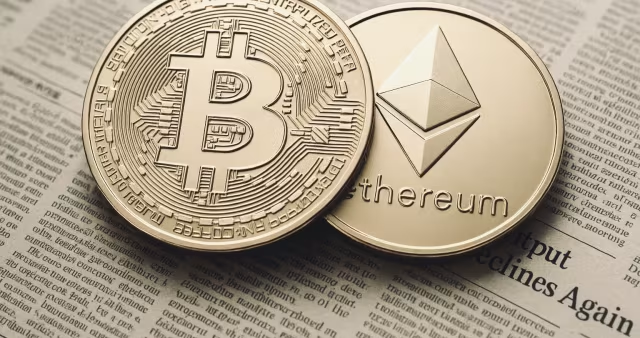
American banking giant JPMorgan Chase & Co. Is preparing to allow institutional clients to use Bitcoin and Ethereum as collateral for loans, in a historic step towards integrating digital assets into the traditional financial system, according to a Bloomberg report.
According to Bloomberg sources, the program is expected to launch by the end of 2025 and will allow clients to secure loans or lines of credit by pledging their cryptocurrencies, without having to sell them. JPMorgan will use third-party custodians to safeguard the assets, avoiding holding the cryptocurrencies directly on its balance sheet.
The development follows the bank's previous decision to accept crypto-linked ETFs, such as the iShares Bitcoin Trust, as collateral for some types of loans. This step is seen as one of the most significant integrations of digital assets in the US banking sector.
According to Bloomberg, the program will initially be available only to institutional and wealth management clients, while the participation of individual (retail) clients is expected to be postponed until later. Operational details such as the loan-to-value (LTV) ratio, interest rates and risk mechanisms have not yet been made public.
JPMorgan has been among the first traditional institutions to develop a consistent strategy towards blockchain technology. The bank has created JPM Coin, a digital currency based on a private blockchain, used for instant interbank transfers between institutional clients.
In addition, it has developed the Kinexys by JPMorgan platform, which offers solutions for tokenized payments, real-time clearing and settlement, as well as experiments with centralized digital deposits (CBDC) in cooperation with central banks.
This step by JPMorgan signals a significant change in the way traditional financial institutions perceive blockchain technology and digital assets. Experts say the move could serve as a precedent for other large banks, especially as regulations on the use of cryptocurrencies as collateral become clearer in the US and Europe.
According to Bloomberg sources, the program is expected to launch by the end of 2025 and will allow clients to secure loans or lines of credit by pledging their cryptocurrencies, without having to sell them. JPMorgan will use third-party custodians to safeguard the assets, avoiding holding the cryptocurrencies directly on its balance sheet.
The development follows the bank's previous decision to accept crypto-linked ETFs, such as the iShares Bitcoin Trust, as collateral for some types of loans. This step is seen as one of the most significant integrations of digital assets in the US banking sector.
According to Bloomberg, the program will initially be available only to institutional and wealth management clients, while the participation of individual (retail) clients is expected to be postponed until later. Operational details such as the loan-to-value (LTV) ratio, interest rates and risk mechanisms have not yet been made public.
JPMorgan has been among the first traditional institutions to develop a consistent strategy towards blockchain technology. The bank has created JPM Coin, a digital currency based on a private blockchain, used for instant interbank transfers between institutional clients.
In addition, it has developed the Kinexys by JPMorgan platform, which offers solutions for tokenized payments, real-time clearing and settlement, as well as experiments with centralized digital deposits (CBDC) in cooperation with central banks.
This step by JPMorgan signals a significant change in the way traditional financial institutions perceive blockchain technology and digital assets. Experts say the move could serve as a precedent for other large banks, especially as regulations on the use of cryptocurrencies as collateral become clearer in the US and Europe.

08
Rizvanoll's statement on energy supply causes Bajram's reaction: "64 euros is not the final price"
A statement by the Minister of Economy, Artane Rizvanolli, has prompted the reaction of LDK MP, Hykmete Bajrami, regarding the price and method of energy supply for enterprises that have entered the free market.
Rizvanolli stated that starting from June 1, KEK will supply all enterprises that have not managed to sign new contracts with free market suppliers. According to her, the energy for these enterprises is provided at an average price of 64.55 euros/MWh by the Albanian Electricity Exchange (ALPEX).
According to Bajram, a number of other costs must be added to the price of 64.55 euros: transmission costs and profit of KOSTT, distribution costs and profit of KEDS, costs and profit of KEKO as biller and collector, as well as KEK's own profit. She warned that this figure will only increase in the coming days, emphasizing that on June 2, the price on the ALPEX exchange will reach 99.87 euros per MWh.
Rizvanolli stated that starting from June 1, KEK will supply all enterprises that have not managed to sign new contracts with free market suppliers. According to her, the energy for these enterprises is provided at an average price of 64.55 euros/MWh by the Albanian Electricity Exchange (ALPEX).
According to Bajram, a number of other costs must be added to the price of 64.55 euros: transmission costs and profit of KOSTT, distribution costs and profit of KEDS, costs and profit of KEKO as biller and collector, as well as KEK's own profit. She warned that this figure will only increase in the coming days, emphasizing that on June 2, the price on the ALPEX exchange will reach 99.87 euros per MWh.

09
US and China Agree on Tariffs
The United States and China have reached an agreement to reduce tariffs on each other's goods for a 90-day period, signaling a significant pause in their trade war.
The agreement, announced after high-level negotiations in Geneva, foresees the US reducing tariffs on Chinese imports from 145% to 30%, while China will reduce tariffs on American products from 125% to just 10%.
Officials from both sides described this as a "confidence-building measure" aimed at creating space for broader trade talks and avoiding further escalation.
Global markets reacted positively to the development, with stock indexes rising and commodity prices rising amid optimism for renewed economic cooperation between the two largest economies. Largest in the world.
The agreement, announced after high-level negotiations in Geneva, foresees the US reducing tariffs on Chinese imports from 145% to 30%, while China will reduce tariffs on American products from 125% to just 10%.
Officials from both sides described this as a "confidence-building measure" aimed at creating space for broader trade talks and avoiding further escalation.
Global markets reacted positively to the development, with stock indexes rising and commodity prices rising amid optimism for renewed economic cooperation between the two largest economies. Largest in the world.

10
Increased supply from OPEC+ lowers oil prices on world markets.
After months of deliberate restrictions, OPEC+ has decided to return to a more aggressive production course, increasing global supply by 411,000 barrels per day by June 2025. This is another step towards moving away from the voluntary cut agreement of 2.2 million barrels per day, agreed at the end of last year. But the decision comes at a paradoxical time: oil prices are at their lowest level in four years, with Brent crude reaching the critical figure of just $ 61 per barrel.
At the center of this movement is Saudi Arabia, which until now has led the efforts to keep prices high with discipline. Now, the priority has changed. Instead of price stability, the new strategy focuses on strengthening the market position in the face of competition, especially in a climate where some countries such as Iraq and Kazakhstan have produced beyond their quotas. In the background, unpredictable US policies and geopolitical fluctuations are pushing the cartel countries to act more decisively to maintain their influence.
However, the increase in production does not come without a cost. Analysts warn that an oversupply in a market with weak demand could accelerate the decline in prices and hurt exporting countries. All attention is now focused on the next OPEC+ meeting, which will be held on May 28. It is expected to examine the risks and opportunities to balance the impact in an increasingly unpredictable market.
At the center of this movement is Saudi Arabia, which until now has led the efforts to keep prices high with discipline. Now, the priority has changed. Instead of price stability, the new strategy focuses on strengthening the market position in the face of competition, especially in a climate where some countries such as Iraq and Kazakhstan have produced beyond their quotas. In the background, unpredictable US policies and geopolitical fluctuations are pushing the cartel countries to act more decisively to maintain their influence.
However, the increase in production does not come without a cost. Analysts warn that an oversupply in a market with weak demand could accelerate the decline in prices and hurt exporting countries. All attention is now focused on the next OPEC+ meeting, which will be held on May 28. It is expected to examine the risks and opportunities to balance the impact in an increasingly unpredictable market.