Economy
Monday, October 19, 2026
Trade · Policy · Development

Percentage of Foreign Direct Investment in 2023 lower than in 2008 in relation to GDP
Since declaring independence in 2008, Kosovo has experienced significant economic growth. In 2008, Kosovo’s GDP was 5.19 billion US dollars, while Foreign Direct Investment (FDI) inflows reached 0.54 billion USD or 10.40% of GDP. In 2023, GDP almost doubled, reaching 10.40 billion USD. FDI inflows increased to 0.91 billion USD. However, the FDI to GDP ratio fell to 8.75%, reflecting a relative decrease in the impact of foreign direct investment on the economy. The Real Estate sector was dominant in attracting FDI, mainly diaspora investments in real estate purchases, attracting around 553.32 million USD or around 60.5% of total investments. Strategic sectors, such as ICT (13.94 million USD), and Agriculture (0.78 million USD), recorded low levels of investment compared to their potential for economic and technological development. Data: WorldBank, CBK
Ad space

Has the subsidy of electric heating equipment encouraged an increase in energy consumption?
Recent subsidy policies for electric heating equipment in Kosovo, although aimed at improving energy efficiency and reducing pollution, may have contributed to the unprecedented increase in energy consumption. The government, through these measures, has helped many families switch from traditional heating methods, such as wood and coal, to cleaner and more modern solutions. But this switch has overloaded the energy network and significantly increased demand during the winter, reaching a record level of 1,500 megawatts per hour. Consumption up to 1,500 megawatts per hour is being covered by local production and imports, which are reaching up to 500 megawatts per hour. KESCO has made a strong appeal to citizens to save electricity, taking special care when using electric heating, in order to relieve pressure on the network and avoid problems.
In this section

Economy
Record Level of Electricity Consumption in Kosovo
Kosovo is facing a record level of electricity consumption, which has reached up to 1500 megawatts per hour, a historic figure for the country. The extraordinary increase in demand, especially during the cold days of winter due to electric heating, has caused overloads in some parts of the distribution network. KESCO has made a strong appeal to citizens to save electricity, paying particular attention to the use of electric heating, in order to relieve pressure on the network and avoid problems. Consumption of up to 1500 megawatts per hour is being covered by local production and imports, which are reaching up to 500 megawatts per hour. Citizens' cooperation is essential to cope with this situation and maintain the stability of supply, KESCO added

Economy
Strategic Alliance: Honda and Nissan Towards Global Dominance
Japanese automakers Honda and Nissan have announced plans for a $58 billion merger, which they aim to complete by 2026. The merger would create the world's third-largest automaker by sales, behind Toyota and Volkswagen. The two companies have signed a memorandum of understanding and aim to reach a final agreement by June, with the merger scheduled for completion in 2026. Mitsubishi Motors, which has been allied with Nissan since 2016, could also join, having signed a separate memorandum and is expected to decide on its participation next month. The merger is aimed at countering growing competition from Chinese automakers and major changes in the market.

Economy
MetaMask and Mastercard join forces for new US Cryptocurrency Card
MetaMask and Mastercard are launching a new cryptocurrency debit card in the US. The partnership aims to simplify the way users access and spend digital assets. The card will be directly linked to the MetaMask wallet, allowing users to make instant transactions in stores and online, just like with traditional cards. In addition, it will enable the automatic conversion of cryptocurrencies into US dollars at checkout, eliminating the need for intermediary platforms. This launch represents an important step towards mass adoption of cryptocurrencies. With the security and reliability that Mastercard offers, this card is expected to drive an increase in the use of cryptocurrencies for everyday transactions. The advanced technology and easy access it offers aim to make this innovation accessible to a wider audience, bringing digital assets closer to the traditional economy.
More headlines

06
Volkswagen workers in Germany protest wage cuts
On Monday, Volkswagen workers across Germany staged a warning strike, halting production at several major plants. The conflict with the company’s management has escalated over plans for pay cuts, job cuts and plant closures. The IG Metall union reported that around 66,000 workers from nine plants took part in Monday’s protests, including 35,000 workers at the central plant in Wolfsburg alone. Volkswagen, one of Germany’s largest employers with 300,000 employees in total, is facing serious challenges in the electric vehicle market. Weak demand, growing competition from Chinese manufacturers and high energy and raw material costs have prompted the company to propose drastic measures to remain competitive. Among its proposals are a 10% pay cut, a decision that has angered unions. Clashes between the company and the IG Metall union have intensified in recent weeks, as workers fiercely oppose the plans for cuts. The protests are seen as a sign of the workforce's determination to defend their rights and working conditions in the face of major changes that Volkswagen intends to implement.
07
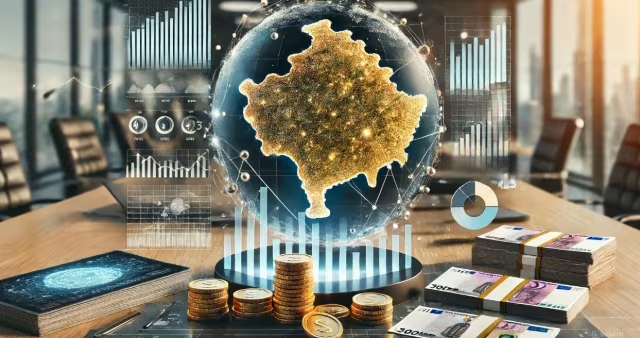
Economic Indicators: Kosovo last in the region in GDP per capita
According to data from the International Monetary Fund (IMF), the GDP per capita in the Balkan countries for 2024 presents a diverse picture, reflecting large differences in regional economic development. Slovenia shows the highest performance with a GDP per capita of 34.54 thousand USD, demonstrating economic stability and a high standard of living. Kosovo, with a GDP per capita of 6.33 thousand USD, stands at the bottom, highlighting structural challenges that require solutions. GDP per capita is an economic measure that represents the total value of goods and services produced in a country during a year, divided by the population of that country. It is widely used as an indicator of the standard of living and the level of overall economic well-being of a country. It also provides an easy comparison between countries to assess the relative level of economic development.
08
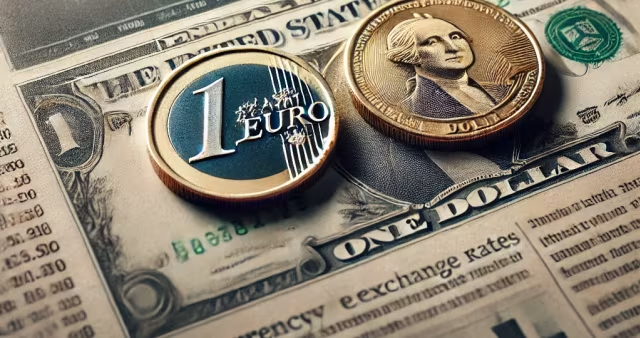
The Euro risks equaling the US Dollar
The eurozone currency has fallen to its lowest level in two years, threatening to reach parity with the US dollar, as economic indicators point to a significant slowdown. The euro’s weakness reflects concerns about sluggish economic growth and the effects of high inflation, which are affecting key manufacturing and service sectors. Survey results show a continued decline in economic activity in many eurozone countries, reinforcing expectations for further monetary measures from the European Central Bank (ECB). Financial analysts warn that if the euro’s weakness continues, parity with the dollar could happen very soon. This would be the first time the common currency has fallen to this level in more than two decades. The parity could have important consequences for international trade, raising the cost of imports for eurozone countries but making exports more competitive in global markets. This development comes at a time when major global economies are facing similar challenges, but the eurozone appears to be particularly vulnerable. Investors are closely watching the ECB's next steps as it faces pressure to balance economic growth and inflation. The euro's continued weakness could have a broad impact on global markets and the region's future economic policies.

09
Kosovo continues to increase its dependence on Chinese goods
Kosovo is facing a significant increase in imports from China, reflecting a growing dependence on Chinese goods. The latest economic data show a continuous upward trend in the import of goods from China, including the year 2024 until October. In 2021, the total value of goods imported from China was 452 million euros. In 2022, this figure increased to 548 million euros, marking a significant increase of over 21%. In 2023, imports from China reached 650 million euros, another increase of 18.5% compared to the previous year. In 2024 (until October), the value of imports from China has reached 614.7 million euros, indicating that the high trend of dependence on Chinese goods is continuing. Comparing the net weight of imported goods shows an important dimension of this increase. The net weight of goods imported from China has increased significantly. This shows that the increase is not only the result of inflation or price increases, but also of a larger volume of imported goods. This fact underlines the large increase in demand for Chinese goods in Kosovo.

10
Has inflation increased household debt?
Rising inflation has led to rising household debt, with many Kosovor families relying on loans and credit cards to meet their financial needs. To cope with the impact of inflation, citizens are turning to credit cards to cover the rising costs of living. Financial hardship is evident, with many people reporting spending cuts and delays in paying bills. In recent years, consumer credit has increased significantly. According to the latest data, by September 2023, consumer debt had reached 450.2 million euros, marking an increase of 7.1% compared to the previous year. Credit card debt has also seen a significant increase. In 2020, credit card debt was 88.2 million euros, while by September 2023, this amount had reached 112.5 million euros. Faced with inflationary pressures, citizens have relied on credit cards as a flexible and immediate source of finance, reflecting the growing dependence on credit to meet economic challenges.