Economy
Monday, October 19, 2026
Trade · Policy · Development

US and Ukraine sign critical minerals agreement
The United States and Ukraine have signed a long-awaited agreement aimed at strengthening economic and strategic cooperation between the two countries. The agreement includes the creation of the U.S.-Ukraine Reconstruction Investment Fund, an initiative aimed at channeling international investment into Ukraine's post-war reconstruction while giving U.S. Companies preferential access to Ukraine's precious natural resources.
The agreement covers important resources such as lithium, titanium, graphite and rare earth elements, which are essential for modern technologies, including electric vehicles, artificial intelligence infrastructure and defense systems. Under the terms of the agreement, Ukraine retains full ownership of these resources, while 50% of the revenue from new exploitation licenses will go to a joint reconstruction fund.
This fund will be jointly managed by the Ukrainian government and the U.S. Development Finance Corporation (DFC), seeking to attract foreign capital to infrastructure, energy, and technology projects in Ukraine. The agreement does not include any debt obligations for Ukraine, presenting it as a fair economic partnership, not classic financial aid.
The agreement comes after months of intensive negotiations and is seen as a clear sign of the U.S.'s long-term commitment to supporting a free, sovereign, and prosperous Ukraine.
The agreement covers important resources such as lithium, titanium, graphite and rare earth elements, which are essential for modern technologies, including electric vehicles, artificial intelligence infrastructure and defense systems. Under the terms of the agreement, Ukraine retains full ownership of these resources, while 50% of the revenue from new exploitation licenses will go to a joint reconstruction fund.
This fund will be jointly managed by the Ukrainian government and the U.S. Development Finance Corporation (DFC), seeking to attract foreign capital to infrastructure, energy, and technology projects in Ukraine. The agreement does not include any debt obligations for Ukraine, presenting it as a fair economic partnership, not classic financial aid.
The agreement comes after months of intensive negotiations and is seen as a clear sign of the U.S.'s long-term commitment to supporting a free, sovereign, and prosperous Ukraine.
Ad space

California overtakes Japan to become world's fourth-largest economy
California has surpassed Japan and now officially holds the fourth place in the ranking of the largest economies in the world, according to the latest data from the International Monetary Fund and the US Bureau of Economic Analysis. With a Gross Domestic Product (GDP) of $4.1 trillion in 2024, California has left behind Japan, which had a GDP of $4.02 trillion.
California's rapid economic growth, which reached 6% in 2024, has helped it surpass not only Japan, but also the growth rates of the US economy itself (5.3%), as well as those of China (2.6%) and Germany (2.9%). The economic success of America's most populous state is based on strong sectors such as technology, entertainment, manufacturing and agriculture.
Governor Gavin Newsom highlighted the achievement as a testament to California's potential and its major contribution to the American economy. He also noted that the state of California contributes more than $83 billion more to the federal budget than it receives, which puts it in a unique position nationally.
California's rapid economic growth, which reached 6% in 2024, has helped it surpass not only Japan, but also the growth rates of the US economy itself (5.3%), as well as those of China (2.6%) and Germany (2.9%). The economic success of America's most populous state is based on strong sectors such as technology, entertainment, manufacturing and agriculture.
Governor Gavin Newsom highlighted the achievement as a testament to California's potential and its major contribution to the American economy. He also noted that the state of California contributes more than $83 billion more to the federal budget than it receives, which puts it in a unique position nationally.
In this section

Economy
Gold Hits Historic Record: Reaches Over $3,500
The price of gold has reached a new historical record, crossing the threshold of $ 3,500 per ounce for the first time. On Tuesday, April 22, 2025, gold touched the value of $ 3,500.00 per ounce in international markets, marking an increase of over 30% since the beginning of this year.
Many investors are looking at gold as a safe haven for their capital. Exchange-traded funds (ETFs) that rely on gold have reported the highest levels of holdings since September 2023, demonstrating a strong interest in this precious metal.
Analysts warn that if this trend continues, the price of gold could increase further in the coming months. Some projections put the price of gold at up to $3,700 per ounce by the end of 2025, if economic and political tensions do not ease.
This latest move in gold markets is a clear indication of the global climate of uncertainty and the continued role that gold plays as a traditional store of value in times of crisis.
Many investors are looking at gold as a safe haven for their capital. Exchange-traded funds (ETFs) that rely on gold have reported the highest levels of holdings since September 2023, demonstrating a strong interest in this precious metal.
Analysts warn that if this trend continues, the price of gold could increase further in the coming months. Some projections put the price of gold at up to $3,700 per ounce by the end of 2025, if economic and political tensions do not ease.
This latest move in gold markets is a clear indication of the global climate of uncertainty and the continued role that gold plays as a traditional store of value in times of crisis.
Economy
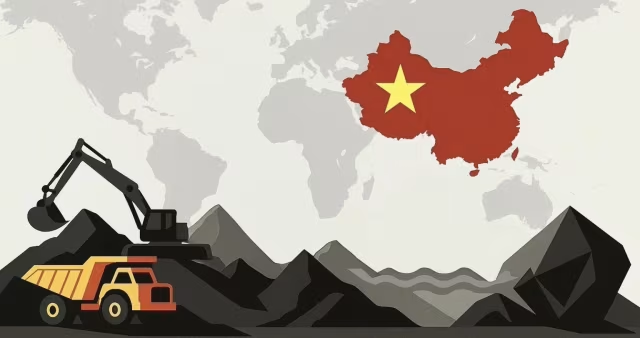
Silent Monopoly: 90% of Rare Earth Mineral Processing in Beijing's Hands
China's control over the global rare earths supply chain has raised deep concerns, particularly about its impact on the strategic energy, technology and defence sectors, at a time when demand for these resources is growing steadily.
China currently accounts for over 70% of the world's production of rare earths. These are essential materials for the production of wind turbines, electric vehicles, smartphones, semiconductors and military equipment. Among the most important minerals are those containing neodymium, dysprosium and praseodymium.
Even more worrying is China's dominance in industrial processing, with over 90% of the global capacity for refining and separating these minerals located within its territory. This means that even if rare earth minerals are mined in other countries, they are often shipped to China for processing, due to its advanced infrastructure and long-standing technological expertise.
This gives Beijing a powerful strategic advantage, especially against countries that depend on these materials for sensitive technology and military equipment. China's imposition of export restrictions on some of these minerals has raised alarm in international markets.
To reduce dependence on China, countries such as the United States and the European Union are taking steps to diversify sources and develop domestic rare earth processing capacities.
Although efforts to build an independent supply chain have intensified, experts warn that this process will require considerable time and large investments. At a time when the world is shifting development towards clean energy and sustainable technologies, ensuring a stable and reliable supply of rare earth minerals is becoming a global strategic priority.
China currently accounts for over 70% of the world's production of rare earths. These are essential materials for the production of wind turbines, electric vehicles, smartphones, semiconductors and military equipment. Among the most important minerals are those containing neodymium, dysprosium and praseodymium.
Even more worrying is China's dominance in industrial processing, with over 90% of the global capacity for refining and separating these minerals located within its territory. This means that even if rare earth minerals are mined in other countries, they are often shipped to China for processing, due to its advanced infrastructure and long-standing technological expertise.
This gives Beijing a powerful strategic advantage, especially against countries that depend on these materials for sensitive technology and military equipment. China's imposition of export restrictions on some of these minerals has raised alarm in international markets.
To reduce dependence on China, countries such as the United States and the European Union are taking steps to diversify sources and develop domestic rare earth processing capacities.
Although efforts to build an independent supply chain have intensified, experts warn that this process will require considerable time and large investments. At a time when the world is shifting development towards clean energy and sustainable technologies, ensuring a stable and reliable supply of rare earth minerals is becoming a global strategic priority.
Economy
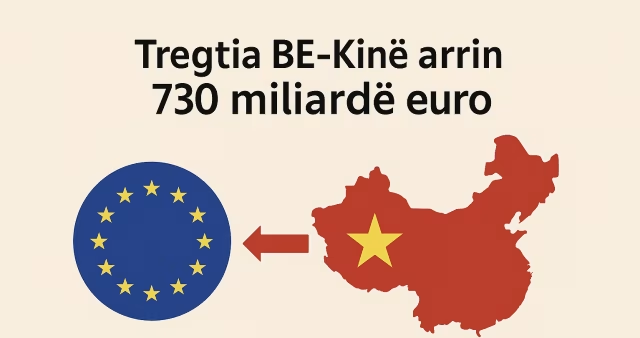
EU-China trade reaches 730 billion euros
Trade relations between the European Union and China remained strong, with large import and export volumes, but with a noticeable imbalance that continues to widen to the detriment of the EU. Trade in goods between the two sides for 2024 reached a total of around €731 billion, including a deficit of more than €300 billion for the European bloc.
During 2024, the EU exported goods to China worth €213.3 billion and imported goods from China worth €517.8 billion. Compared to 2023, exports fell by 4.5%, while imports slightly decreased by 0.5%.
In the period 2014–2024, EU imports from China increased by 101.9%, while exports increased by 47.0%. This shows an uneven rate of growth and highlights the ongoing challenge of creating a more balanced trading relationship between the two partners.
The most important goods that the EU imported from China include telecommunications and audio equipment, personal computers, office equipment and electrical machinery. Meanwhile, the EU's main exports to China include heavy machinery, vehicles and vehicle spare parts.
In addition to trade in goods, EU-China economic relations are also characterised by significant investment exchanges. The cumulative value of EU foreign direct investment (FDI) in China since 2000 reached €177 billion in the first quarter of 2024. The three main sectors of investment were: the automotive industry, basic materials and machinery. Meanwhile, the cumulative value of Chinese investment in the EU-27 countries for the same period reached €143 billion. Chinese investments are mainly concentrated in three main sectors: automotive, healthcare, pharmaceuticals and biotechnology, as well as information and communication technologies.
Against the backdrop of these figures, European leaders have stressed the importance of fairer and more equitable trade with China, calling for concrete measures to address the internal barriers that European companies face in the Chinese market.
The EU continues to remain one of China's main economic partners, while China is one of the most important markets for European products and technologies. However, issues such as intellectual property protection, state subsidies and the lack of equal access to the Chinese market remain key challenges to sustainable economic cooperation.
During 2024, the EU exported goods to China worth €213.3 billion and imported goods from China worth €517.8 billion. Compared to 2023, exports fell by 4.5%, while imports slightly decreased by 0.5%.
In the period 2014–2024, EU imports from China increased by 101.9%, while exports increased by 47.0%. This shows an uneven rate of growth and highlights the ongoing challenge of creating a more balanced trading relationship between the two partners.
The most important goods that the EU imported from China include telecommunications and audio equipment, personal computers, office equipment and electrical machinery. Meanwhile, the EU's main exports to China include heavy machinery, vehicles and vehicle spare parts.
In addition to trade in goods, EU-China economic relations are also characterised by significant investment exchanges. The cumulative value of EU foreign direct investment (FDI) in China since 2000 reached €177 billion in the first quarter of 2024. The three main sectors of investment were: the automotive industry, basic materials and machinery. Meanwhile, the cumulative value of Chinese investment in the EU-27 countries for the same period reached €143 billion. Chinese investments are mainly concentrated in three main sectors: automotive, healthcare, pharmaceuticals and biotechnology, as well as information and communication technologies.
Against the backdrop of these figures, European leaders have stressed the importance of fairer and more equitable trade with China, calling for concrete measures to address the internal barriers that European companies face in the Chinese market.
The EU continues to remain one of China's main economic partners, while China is one of the most important markets for European products and technologies. However, issues such as intellectual property protection, state subsidies and the lack of equal access to the Chinese market remain key challenges to sustainable economic cooperation.
More headlines

06
Trump threatens China with new 50% tariffs
Donald Trump threatened that the US will impose an additional 50% tariff on imports from China if China does not immediately withdraw its 34% tariff on American goods by April 8.
In a post on his Truth Social platform, Trump said that if China does not comply, the new tariffs will take effect on April 9 and all trade negotiations with China will be suspended.
This escalation comes after a round of reciprocal tariffs, where the US initially imposed a 34% tariff on Chinese products and China retaliated with the same percentage on American products. With the additional tariff proposed by Trump, the total tariffs on Chinese goods could exceed 100%.
The news caused major fluctuations in financial markets, with shares of Alibaba Group Holding Ltd (BABA) falling significantly by 9.06%, closing at 105.98 US dollars.
In a post on his Truth Social platform, Trump said that if China does not comply, the new tariffs will take effect on April 9 and all trade negotiations with China will be suspended.
This escalation comes after a round of reciprocal tariffs, where the US initially imposed a 34% tariff on Chinese products and China retaliated with the same percentage on American products. With the additional tariff proposed by Trump, the total tariffs on Chinese goods could exceed 100%.
The news caused major fluctuations in financial markets, with shares of Alibaba Group Holding Ltd (BABA) falling significantly by 9.06%, closing at 105.98 US dollars.

07
Customs for America: The Asymmetric Trade Relationship
The GSP program, a US trade initiative to stimulate economic development in developing countries, has allowed a wide range of products from Kosovo, including agricultural products, manufactured goods and handicrafts, to enter the US market duty-free since 2008.
While Kosovo has enjoyed preferential access to the US market for years through the Generalised System of Preferences (GSP) by exporting duty-free to the US, it continues to apply tariffs on US goods, up to 10%. Unlike trading partners such as the EU or CEFTA countries, the US does not enjoy preferential treatment in the Kosovo market.
In this context, in April 2025, the administration of President Donald Trump announced the imposition of a 10% tariff on imports from Kosovo. These tariffs were introduced as part of a strategy to promote trade reciprocity and balance one-sided relations with smaller economic partners.
But how is it possible for Kosovo to impose customs tariffs on an ally that has been among its biggest supporters on the path to freedom and statehood?
Imposing customs duties on American products, while Kosovor exports entered the US duty-free through the GSP program, was not only unbalanced, but also against the principles of strategic partnership.
The 10% tariff by the Trump administration is an opportunity for Kosovo to recalibrate the trade relationship with its largest ally, not only as an act of gratitude, but as a smart geopolitical strategy.
While Kosovo has enjoyed preferential access to the US market for years through the Generalised System of Preferences (GSP) by exporting duty-free to the US, it continues to apply tariffs on US goods, up to 10%. Unlike trading partners such as the EU or CEFTA countries, the US does not enjoy preferential treatment in the Kosovo market.
In this context, in April 2025, the administration of President Donald Trump announced the imposition of a 10% tariff on imports from Kosovo. These tariffs were introduced as part of a strategy to promote trade reciprocity and balance one-sided relations with smaller economic partners.
But how is it possible for Kosovo to impose customs tariffs on an ally that has been among its biggest supporters on the path to freedom and statehood?
Imposing customs duties on American products, while Kosovor exports entered the US duty-free through the GSP program, was not only unbalanced, but also against the principles of strategic partnership.
The 10% tariff by the Trump administration is an opportunity for Kosovo to recalibrate the trade relationship with its largest ally, not only as an act of gratitude, but as a smart geopolitical strategy.

08
Gold Breaks Record: Price Surpasses $3,000 for the First Time!
The price of gold has reached a record high of $3,000 per ounce for the first time in history, reflecting global concerns about inflation and economic instability. Financial experts point out that the increase in demand for this precious metal comes as a result of trade tensions and the new tariff policies of the US administration, which have added uncertainty to financial markets. In addition, central banks, especially those in China, have expanded their gold reserves, making it an even more valuable asset for investors. In an unstable global context, gold remains a safe haven for investors seeking protection against inflation and the decline of major currencies. Analysts predict that the upward trend may continue, especially if economic and financial policies remain uncertain. However, some experts warn that a rapid increase could also lead to a possible price correction in the short term.

09
Trump Threatens EU with 200% Tariff on Wine and Champagne.
US President Donald Trump has threatened the European Union with a 200% tariff on alcohol products, including French wine and champagne. The warning comes in response to the EU’s decision to impose a 50% tariff on American whiskey, following new US tariffs on steel and aluminium. According to Trump, if the EU does not immediately cancel this measure, he will take tough economic steps to protect American interests. These trade tensions have raised concerns in international markets, as the increase in tariffs could significantly affect prices and trade exchanges between the US and the EU. The European Commission has criticized the US tariffs on metals and has warned of countermeasures if Trump goes ahead with his plan. Experts warn that such a trade conflict between the two largest economies could have consequences for the global economy. The European alcohol industry, particularly French and Italian wine and champagne producers, is expected to be among the hardest hit by the decision. On the other hand, American whiskey producers have expressed concern about the impact that European tariffs could have on their exports.

10
Oil Prices Drop After Trump, Putin Talk About Peace in Ukraine
Oil prices fell sharply on international markets after a phone call between former US President Donald Trump and Russian President Vladimir Putin. During the call, which took place as part of efforts to broker peace in Ukraine, Trump confirmed that the two leaders were willing to start negotiations. The development raised hopes for a possible resolution to the conflict, easing concerns about global energy supplies. Oil markets reacted quickly to the news, reflecting expectations that a easing of tensions could lead to an easing of sanctions on Russian oil. Brent crude fell 0.9% to trade at $74.50 a barrel, while WTI (West Texas Intermediate) fell similarly to $70.72 a barrel. Industry experts say investors are closely watching political developments, as any progress in peace talks could have a major impact on the oil market. However, some analysts warn that prices could fluctuate further depending on the progress of negotiations and future decisions by international leaders.