Op-Ed
Monday, October 19, 2026
Opinion · Analysis · Commentary

Were Serbian documents used to bypass travel restrictions?
The history of Kosovo passports reflects the territory’s political transformation over the past decades. After the Kosovo War, the United Nations Mission in Kosovo (UNMIK) introduced a travel document to enable residents of Kosovo to travel abroad. However, the document faced significant restrictions, as only a limited number of countries recognized it for entry in its early years, making international travel difficult for many residents.
By 2004, several states had begun accepting the document, including Albania, North Macedonia, Montenegro, Turkey, Germany, and Switzerland, usually with visa requirements. Recognition varied widely between countries, and travelers often faced additional procedures or restrictions at borders, making international mobility during that period complicated for Kosovo residents.
During this period, residents continued to travel using Serbian passports, particularly businesspeople who needed easier international mobility.
In practice, many entrepreneurs and traders relied on Serbian passports to travel abroad for commerce, especially to markets such as China, where trade links and visa procedures were more accessible with those documents. In many cases, these passports were relatively easy to obtain within the country for individuals with sufficient financial means making them a practical solution for those engaged in international trade.
Over time, a growing number of countries stopped accepting Serbian passports when Kosovo appeared as the place of issuance.
As restrictions increased, a new practice emerged. Many residents began obtaining Serbian passports registered in municipalities outside Kosovo, especially in areas such as Presheva and surrounding towns. Registering the documents in these locations allowed travelers to avoid limitations applied to passports issued within Kosovo and maintain access to international travel.
A major turning point came when Kosovo declared independence and began issuing its own passports under the authority of the Government of the Republic of Kosovo. In recent years, mobility has significantly improved, including visa-free travel to the Schengen Area.
However, challenges remain, as several countries that do not recognize Kosovo continue to impose restrictions or do not accept the passport, meaning that full global travel freedom is still not uniformly guaranteed for Kosovo citizens.
By 2004, several states had begun accepting the document, including Albania, North Macedonia, Montenegro, Turkey, Germany, and Switzerland, usually with visa requirements. Recognition varied widely between countries, and travelers often faced additional procedures or restrictions at borders, making international mobility during that period complicated for Kosovo residents.
During this period, residents continued to travel using Serbian passports, particularly businesspeople who needed easier international mobility.
In practice, many entrepreneurs and traders relied on Serbian passports to travel abroad for commerce, especially to markets such as China, where trade links and visa procedures were more accessible with those documents. In many cases, these passports were relatively easy to obtain within the country for individuals with sufficient financial means making them a practical solution for those engaged in international trade.
Over time, a growing number of countries stopped accepting Serbian passports when Kosovo appeared as the place of issuance.
As restrictions increased, a new practice emerged. Many residents began obtaining Serbian passports registered in municipalities outside Kosovo, especially in areas such as Presheva and surrounding towns. Registering the documents in these locations allowed travelers to avoid limitations applied to passports issued within Kosovo and maintain access to international travel.
A major turning point came when Kosovo declared independence and began issuing its own passports under the authority of the Government of the Republic of Kosovo. In recent years, mobility has significantly improved, including visa-free travel to the Schengen Area.
However, challenges remain, as several countries that do not recognize Kosovo continue to impose restrictions or do not accept the passport, meaning that full global travel freedom is still not uniformly guaranteed for Kosovo citizens.
Ad space
Operation Spider's Web rewrites the rules of modern warfare
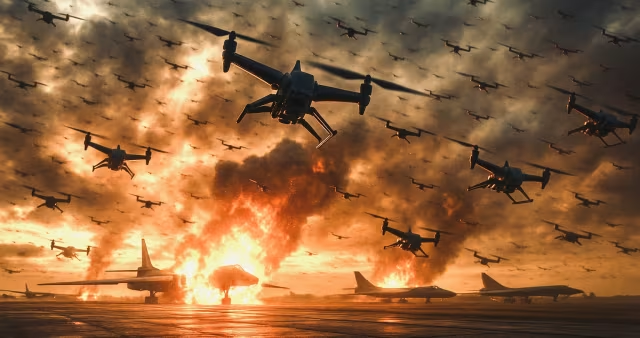
In one of the most innovative military operations of the war so far, Ukraine launched a coordinated and massive drone strike deep inside Russian territory on June 1, 2025. Codenamed Operation Spider Web, it targeted five strategic air bases in Siberia and the Arctic Circle. More than 100 FPV drones, guided by artificial intelligence, were used to strike targets with high precision. According to reports, 41 Russian military aircraft, including strategic bombers, were destroyed or damaged.
Unlike traditional operations, the offensive was carried out without violating Russian airspace with pilots. The drones were introduced into Russian territory hidden inside wooden structures mounted on transport trucks. Once they reached the vicinity of the targets, they were remotely launched and operated autonomously. Equipped with advanced AI algorithms, they identified critical parts of the aircraft, such as fuel tanks and engines, striking with high efficiency.
At a cost of only about $500 per unit, Ukraine managed to inflict billions of dollars in damage to Russian air infrastructure. The use of swarm tactics made these drones particularly difficult to detect and neutralize by air defenses, exposing deep weaknesses in traditional defense systems. This is a clear example of how low-cost technology can defeat conventional military power.
International observers see Operation Spider Web as a new model of warfare for the 21st century. With unmanned systems and artificial intelligence at the center of strategy, countries will be forced to rethink air defense, military preparedness, and the ethical framework that governs the use of such weapons. The Ukrainian operation may have ushered in a new era where wars are fought more with algorithms than with tanks.
As Ukraine and Russia are expected to sit down for peace talks in Istanbul, the attack serves as a clear message: technological superiority and innovation are now the defining factors of power. In this new military reality, drones are not just new weapons; they are changing the very definition of war and the rules that govern it.
Unlike traditional operations, the offensive was carried out without violating Russian airspace with pilots. The drones were introduced into Russian territory hidden inside wooden structures mounted on transport trucks. Once they reached the vicinity of the targets, they were remotely launched and operated autonomously. Equipped with advanced AI algorithms, they identified critical parts of the aircraft, such as fuel tanks and engines, striking with high efficiency.
At a cost of only about $500 per unit, Ukraine managed to inflict billions of dollars in damage to Russian air infrastructure. The use of swarm tactics made these drones particularly difficult to detect and neutralize by air defenses, exposing deep weaknesses in traditional defense systems. This is a clear example of how low-cost technology can defeat conventional military power.
International observers see Operation Spider Web as a new model of warfare for the 21st century. With unmanned systems and artificial intelligence at the center of strategy, countries will be forced to rethink air defense, military preparedness, and the ethical framework that governs the use of such weapons. The Ukrainian operation may have ushered in a new era where wars are fought more with algorithms than with tanks.
As Ukraine and Russia are expected to sit down for peace talks in Istanbul, the attack serves as a clear message: technological superiority and innovation are now the defining factors of power. In this new military reality, drones are not just new weapons; they are changing the very definition of war and the rules that govern it.
In this section
Op-Ed
Silent Monopoly: 90% of Rare Earth Mineral Processing in Beijing's Hands
China's control over the global rare earths supply chain has raised deep concerns, particularly about its impact on the strategic energy, technology and defence sectors, at a time when demand for these resources is growing steadily.
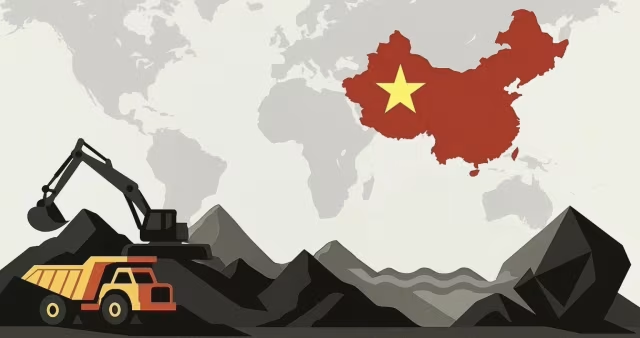
China currently accounts for over 70% of the world's production of rare earths. These are essential materials for the production of wind turbines, electric vehicles, smartphones, semiconductors and military equipment. Among the most important minerals are those containing neodymium, dysprosium and praseodymium.
Even more worrying is China's dominance in industrial processing, with over 90% of the global capacity for refining and separating these minerals located within its territory. This means that even if rare earth minerals are mined in other countries, they are often shipped to China for processing, due to its advanced infrastructure and long-standing technological expertise.
This gives Beijing a powerful strategic advantage, especially against countries that depend on these materials for sensitive technology and military equipment. China's imposition of export restrictions on some of these minerals has raised alarm in international markets.
To reduce dependence on China, countries such as the United States and the European Union are taking steps to diversify sources and develop domestic rare earth processing capacities.
Although efforts to build an independent supply chain have intensified, experts warn that this process will require considerable time and large investments. At a time when the world is shifting development towards clean energy and sustainable technologies, ensuring a stable and reliable supply of rare earth minerals is becoming a global strategic priority.
China currently accounts for over 70% of the world's production of rare earths. These are essential materials for the production of wind turbines, electric vehicles, smartphones, semiconductors and military equipment. Among the most important minerals are those containing neodymium, dysprosium and praseodymium.
Even more worrying is China's dominance in industrial processing, with over 90% of the global capacity for refining and separating these minerals located within its territory. This means that even if rare earth minerals are mined in other countries, they are often shipped to China for processing, due to its advanced infrastructure and long-standing technological expertise.
This gives Beijing a powerful strategic advantage, especially against countries that depend on these materials for sensitive technology and military equipment. China's imposition of export restrictions on some of these minerals has raised alarm in international markets.
To reduce dependence on China, countries such as the United States and the European Union are taking steps to diversify sources and develop domestic rare earth processing capacities.
Although efforts to build an independent supply chain have intensified, experts warn that this process will require considerable time and large investments. At a time when the world is shifting development towards clean energy and sustainable technologies, ensuring a stable and reliable supply of rare earth minerals is becoming a global strategic priority.

Op-Ed
Customs for America: The Asymmetric Trade Relationship
The GSP program, a US trade initiative to stimulate economic development in developing countries, has allowed a wide range of products from Kosovo, including agricultural products, manufactured goods and handicrafts, to enter the US market duty-free since 2008.
While Kosovo has enjoyed preferential access to the US market for years through the Generalised System of Preferences (GSP) by exporting duty-free to the US, it continues to apply tariffs on US goods, up to 10%. Unlike trading partners such as the EU or CEFTA countries, the US does not enjoy preferential treatment in the Kosovo market.
In this context, in April 2025, the administration of President Donald Trump announced the imposition of a 10% tariff on imports from Kosovo. These tariffs were introduced as part of a strategy to promote trade reciprocity and balance one-sided relations with smaller economic partners.
But how is it possible for Kosovo to impose customs tariffs on an ally that has been among its biggest supporters on the path to freedom and statehood?
Imposing customs duties on American products, while Kosovor exports entered the US duty-free through the GSP program, was not only unbalanced, but also against the principles of strategic partnership.
The 10% tariff by the Trump administration is an opportunity for Kosovo to recalibrate the trade relationship with its largest ally, not only as an act of gratitude, but as a smart geopolitical strategy.
While Kosovo has enjoyed preferential access to the US market for years through the Generalised System of Preferences (GSP) by exporting duty-free to the US, it continues to apply tariffs on US goods, up to 10%. Unlike trading partners such as the EU or CEFTA countries, the US does not enjoy preferential treatment in the Kosovo market.
In this context, in April 2025, the administration of President Donald Trump announced the imposition of a 10% tariff on imports from Kosovo. These tariffs were introduced as part of a strategy to promote trade reciprocity and balance one-sided relations with smaller economic partners.
But how is it possible for Kosovo to impose customs tariffs on an ally that has been among its biggest supporters on the path to freedom and statehood?
Imposing customs duties on American products, while Kosovor exports entered the US duty-free through the GSP program, was not only unbalanced, but also against the principles of strategic partnership.
The 10% tariff by the Trump administration is an opportunity for Kosovo to recalibrate the trade relationship with its largest ally, not only as an act of gratitude, but as a smart geopolitical strategy.