Technology
Monday, October 19, 2026
Innovation · Trends · Analysis

Perplexity in talks to bring its AI to Samsung phones
Artificial intelligence company Perplexity AI is in early talks with Samsung Electronics to bring its advanced assistant to the brand's smartphones. According to sources familiar with the matter, possibilities for a collaboration include offering Perplexity as an alternative assistant for Samsung users, pre-bundling the app on new devices or promoting it through the Galaxy Store.
The development comes on the heels of a similar deal that Perplexity reached with Motorola, where it is expected to launch the assistant on its phones during an event scheduled in New York on April 24. This move puts Perplexity in a strong position to challenge current assistants like Google Gemini and Bixby, especially in the area of real-time search and instant responses, similar to a smart search engine.
Samsung, on the other hand, has a history of collaborating with Google on artificial intelligence technologies in Galaxy AI, which makes this discussion with Perplexity a bold and potentially challenging step. However, the existing connection through investments – as Samsung NEXT has already invested in Perplexity – could ease the way for a new strategic agreement. Samsung is also reportedly considering a second investment, which could increase the value of Perplexity to over $18 billion.
If the deal is finalized, Samsung users could benefit from a new experience of interacting with artificial intelligence, which goes beyond basic commands and is oriented towards a more advanced form of search and virtual assistant. More details are expected to emerge in the coming weeks on how and when Perplexity will be integrated into the Samsung ecosystem.
The development comes on the heels of a similar deal that Perplexity reached with Motorola, where it is expected to launch the assistant on its phones during an event scheduled in New York on April 24. This move puts Perplexity in a strong position to challenge current assistants like Google Gemini and Bixby, especially in the area of real-time search and instant responses, similar to a smart search engine.
Samsung, on the other hand, has a history of collaborating with Google on artificial intelligence technologies in Galaxy AI, which makes this discussion with Perplexity a bold and potentially challenging step. However, the existing connection through investments – as Samsung NEXT has already invested in Perplexity – could ease the way for a new strategic agreement. Samsung is also reportedly considering a second investment, which could increase the value of Perplexity to over $18 billion.
If the deal is finalized, Samsung users could benefit from a new experience of interacting with artificial intelligence, which goes beyond basic commands and is oriented towards a more advanced form of search and virtual assistant. More details are expected to emerge in the coming weeks on how and when Perplexity will be integrated into the Samsung ecosystem.
Ad space

80,000 Web Pages Attacked by Spambot Using GPT
An advanced spambot, known as AkiraBot, has been using OpenAI's artificial intelligence to spread spam on tens of thousands of websites worldwide. According to a report published by cybersecurity firm SentinelOne, the attack targeted small and medium-sized businesses operating through platforms such as Shopify, Wix, GoDaddy and Squarespace.
AkiraBot used OpenAI's GPT-4o-mini model to generate personalized marketing messages, which it then posted on contact forms and live chats across websites. The goal: to convince website owners to purchase fake SEO services. To avoid automated filters, each message was slightly different from the next – just enough to avoid being detected as spam.
But AkiraBot’s operation wasn’t just a flurry of automated messages. It used multiple tools to evade CAPTCHAs, as well as proxy networks to disguise the source of the traffic, making the attack difficult to identify.
After discovering the suspicious activity, OpenAI intervened by disabling the API key that AkiraBot had been using, temporarily putting an end to this abuse of AI technology. The incident is another example of the dangers posed by the misuse of artificial intelligence and the urgent need for stricter regulation and monitoring of its use.
AkiraBot used OpenAI's GPT-4o-mini model to generate personalized marketing messages, which it then posted on contact forms and live chats across websites. The goal: to convince website owners to purchase fake SEO services. To avoid automated filters, each message was slightly different from the next – just enough to avoid being detected as spam.
But AkiraBot’s operation wasn’t just a flurry of automated messages. It used multiple tools to evade CAPTCHAs, as well as proxy networks to disguise the source of the traffic, making the attack difficult to identify.
After discovering the suspicious activity, OpenAI intervened by disabling the API key that AkiraBot had been using, temporarily putting an end to this abuse of AI technology. The incident is another example of the dangers posed by the misuse of artificial intelligence and the urgent need for stricter regulation and monitoring of its use.
In this section

Technology
OpenAI is building its own social network to challenge X and Meta
Leading artificial intelligence company OpenAI is working on a new social network that aims to compete with existing platforms like X (formerly Twitter) and Meta. The project is still in its early stages, but an internal prototype is reportedly already in place that focuses on a feed of posts based on content created by ChatGPT, specifically images generated by artificial intelligence.
The main goal of this platform is to create a space where users can share creative content created with the help of OpenAI's tools. This will help the company collect high-quality data to improve its AI models, similar to what Elon Musk is doing with the X platform and his Grok system. In this way, OpenAI aims to become less dependent on external data sources to train its models.
It is not yet known whether the new social network will be a standalone app or will be integrated within the existing ChatGPT app. However, OpenAI CEO Sam Altman is said to be seeking input from external parties to guide the development of the platform. This development shows OpenAI's ambition to expand its influence beyond AI and into the social media space.
The main goal of this platform is to create a space where users can share creative content created with the help of OpenAI's tools. This will help the company collect high-quality data to improve its AI models, similar to what Elon Musk is doing with the X platform and his Grok system. In this way, OpenAI aims to become less dependent on external data sources to train its models.
It is not yet known whether the new social network will be a standalone app or will be integrated within the existing ChatGPT app. However, OpenAI CEO Sam Altman is said to be seeking input from external parties to guide the development of the platform. This development shows OpenAI's ambition to expand its influence beyond AI and into the social media space.

Technology
Android users targeted: China is using spyware on Android
A coalition of governments, including the United Kingdom, the United States, Canada, Australia, New Zealand and Germany, has issued a joint warning about the use of Android apps that appear legitimate but actually contain spyware known as “BadBazaar” and “Moonshine.” These apps have been used to target individuals and groups associated with issues considered a threat to Chinese state interests.
The spyware has been hidden within apps that mimic popular platforms such as WhatsApp and Skype, as well as culturally specific apps such as “TibetOne” and “Audio Quran.” Once installed, these apps can access sensitive information on a user's device, including messages, photos, location data, and can activate the microphone and camera without the user's knowledge.
The coalition emphasizes the importance of downloading apps only from trusted sources, regularly reviewing app permissions, and reporting any suspicious apps to reduce the risk of spyware infections.
The spyware has been hidden within apps that mimic popular platforms such as WhatsApp and Skype, as well as culturally specific apps such as “TibetOne” and “Audio Quran.” Once installed, these apps can access sensitive information on a user's device, including messages, photos, location data, and can activate the microphone and camera without the user's knowledge.
The coalition emphasizes the importance of downloading apps only from trusted sources, regularly reviewing app permissions, and reporting any suspicious apps to reduce the risk of spyware infections.

Technology
Mira Murati Gathers OpenAI's Elite in Her Startup
Former OpenAI CTO Mira Murati has founded a new artificial intelligence startup, Thinking Machines Lab, which has recruited two prominent advisors: Bob McGrew and Alec Radford. McGrew served as OpenAI's chief research officer until September 2024, while Radford is known for his key role in developing advanced models such as GPT, Whisper, and DALL-E.
Thinking Machines Lab, founded in February 2025, aims to advance artificial intelligence by making it more understandable and customizable for users. The team consists of about 30 researchers and engineers, including former OpenAI employees such as John Schulman as chief scientist and Barret Zoph as chief technology officer.
The addition of McGrew and Radford to the advisory board is expected to strengthen the company's efforts to develop artificial intelligence systems that are more understandable and adaptable to the specific needs of users. Thinking Machines Lab emphasizes open science and practical applications in its mission to bridge the gap between advanced AI capabilities and public understanding.
Thinking Machines Lab, founded in February 2025, aims to advance artificial intelligence by making it more understandable and customizable for users. The team consists of about 30 researchers and engineers, including former OpenAI employees such as John Schulman as chief scientist and Barret Zoph as chief technology officer.
The addition of McGrew and Radford to the advisory board is expected to strengthen the company's efforts to develop artificial intelligence systems that are more understandable and adaptable to the specific needs of users. Thinking Machines Lab emphasizes open science and practical applications in its mission to bridge the gap between advanced AI capabilities and public understanding.
More headlines

06
Amazon submits bid to buy TikTok
Technology company Amazon has submitted an offer to acquire TikTok outright, according to a new report published by The New York Times. The offer comes as the deadline set by US authorities approaches – April 5 – to force Chinese company ByteDance to sell TikTok’s US operations, otherwise the app will face a full ban on American territory.
According to NYT’s sources, Amazon has communicated its offer to senior US government officials, including Vice President J.D. Vance and Commerce Secretary Howard Lutnick.
Amazon is not the only company interested. Other consortiums, including OnlyFans founder Tim Stokely, as well as companies like Oracle and powerful investors like Blackstone and Andreessen Horowitz, have also expressed interest in buying TikTok.
Although Amazon is one of the biggest names in technology, some analysts say its offer may not be taken seriously by all parties involved, due to the major regulatory implications such a deal would bring.
According to NYT’s sources, Amazon has communicated its offer to senior US government officials, including Vice President J.D. Vance and Commerce Secretary Howard Lutnick.
Amazon is not the only company interested. Other consortiums, including OnlyFans founder Tim Stokely, as well as companies like Oracle and powerful investors like Blackstone and Andreessen Horowitz, have also expressed interest in buying TikTok.
Although Amazon is one of the biggest names in technology, some analysts say its offer may not be taken seriously by all parties involved, due to the major regulatory implications such a deal would bring.

07
Amazon introduces an AI agent that uses the browser independently, clicking and filling out forms like a human
Amazon on Monday unveiled Nova Act, a new general artificial intelligence agent that has the ability to independently control a web browser and perform simple actions.
Nova Act is designed to automate common online tasks, including page navigation, button clicking, form filling and basic website interactions, without user intervention.
Along with this advanced agent, Amazon also launched Nova Act SDK – a development kit that allows programmers to build prototypes of their own agents using Nova Act.
The move puts Amazon more strongly in the race to develop Agent AI, a growing field that aims to create autonomous systems that can perform complex tasks with little or no human intervention.
Nova Act is designed to automate common online tasks, including page navigation, button clicking, form filling and basic website interactions, without user intervention.
Along with this advanced agent, Amazon also launched Nova Act SDK – a development kit that allows programmers to build prototypes of their own agents using Nova Act.
The move puts Amazon more strongly in the race to develop Agent AI, a growing field that aims to create autonomous systems that can perform complex tasks with little or no human intervention.

08
The rocket that aimed to put Europe in the space race explodes 40 seconds after launch from European soil.
A test rocket from the German company Isar Aerospace exploded just 40 seconds after liftoff from the Andøya space center in Norway. It was an uncrewed test flight that was intended to usher in the era of independent satellite launches from European soil. The Spectrum rocket lifted off successfully, but a technical fault caused it to veer off course and then end up in the sea, where it exploded.
Despite the failure to reach orbit, Isar Aerospace considered the mission a success. According to CEO Daniel Metzler, the main technical objectives were met, including testing the flight termination system. He stressed that important data was collected during the flight that will help improve technology for future launches.
The flight marks the first attempt to carry out an orbital launch from the European continent (excluding Russia) financed almost entirely by private sources. Europe aims to create a reliable alternative for transporting satellites to orbit, in an increasingly competitive market dominated by SpaceX. Isar Aerospace has already started production of the second and third Spectrum rockets, aiming to return to the launch pad as soon as possible.
Youtube/TheTimes
Despite the failure to reach orbit, Isar Aerospace considered the mission a success. According to CEO Daniel Metzler, the main technical objectives were met, including testing the flight termination system. He stressed that important data was collected during the flight that will help improve technology for future launches.
The flight marks the first attempt to carry out an orbital launch from the European continent (excluding Russia) financed almost entirely by private sources. Europe aims to create a reliable alternative for transporting satellites to orbit, in an increasingly competitive market dominated by SpaceX. Isar Aerospace has already started production of the second and third Spectrum rockets, aiming to return to the launch pad as soon as possible.
Youtube/TheTimes

09
OpenAI introduces the latest technology for creating images with artificial intelligence
OpenAI has unveiled a major development in the field of artificial intelligence, introducing a new feature that allows users to create realistic images through ChatGPT. This advanced technology is based on the latest GPT-4o model, which seamlessly processes text, images, and audio in real time.
With this improvement, users can describe a scene in words and ChatGPT will turn it into a detailed and visually accurate image. The newest feature also includes the ability to edit the image through chat, giving the user complete control over the changes and style of graphic creation.
Unlike previous models, GPT-4o offers a higher level of realism and match between the description and the image. This technology has been made available to all ChatGPT users, including the free version, as well as the Plus, Team and Pro plans.
OpenAI emphasizes that it has put in place strong security measures to prevent inappropriate uses of the technology and that all images created will contain digital marks to indicate their origin from artificial intelligence.
With this improvement, users can describe a scene in words and ChatGPT will turn it into a detailed and visually accurate image. The newest feature also includes the ability to edit the image through chat, giving the user complete control over the changes and style of graphic creation.
Unlike previous models, GPT-4o offers a higher level of realism and match between the description and the image. This technology has been made available to all ChatGPT users, including the free version, as well as the Plus, Team and Pro plans.
OpenAI emphasizes that it has put in place strong security measures to prevent inappropriate uses of the technology and that all images created will contain digital marks to indicate their origin from artificial intelligence.
10
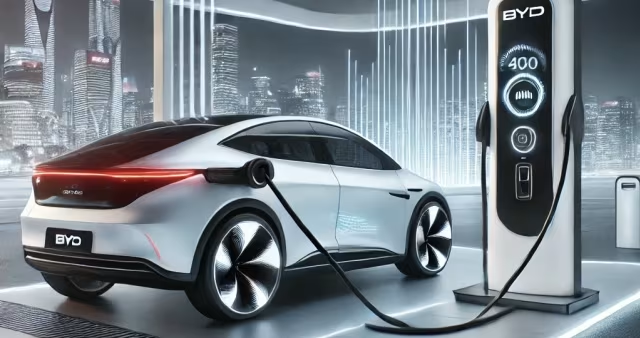
BYD Cuts Electric Vehicle Charging Time to Just 5 Minutes
Chinese company BYD, one of the world’s largest electric car manufacturers, has introduced a new charging technology that allows vehicles to travel 400 km in just 5 minutes. The innovation, part of the Super e-Platform, puts BYD ahead of competitors such as Tesla, significantly reducing charging times and making it easier for consumers to adopt electric cars. The new technology is expected to debut in the Han L sedan and Tang L SUV models, which will be launched in April. Following this news, BYD shares rose by as much as 6%, reaching a record high. The company also announced the construction of 4,000 new charging stations in China, although it did not give an exact timeframe for their implementation. The development could change the electric car market, bringing charging times closer to those of filling up a car with gas, a major advantage in global competition.