Technology
Monday, October 19, 2026
Innovation · Trends · Analysis

Meta plans to launch visual ad personalization based on user location
Meta is transforming the advertising industry with an ambitious new approach, using generative artificial intelligence to automate the creation and personalization of advertising content. The company's latest tools allow advertisers to produce headlines, product descriptions, images and even videos, simply by providing a few instructions such as the type of product, target audience and tone of message. The AI systems will then create different versions of an ad, optimized for different displays.
One of the most impressive plans is AI's ability to personalize ad visuals based on a user's location or context in real time. For example, a car manufacturer running a single campaign could show different versions of an ad to different users: someone in a mountainous area might see the car traveling along a rugged mountain road, while a user in the city might see the same model moving in an urban environment, reports the WSJ. This level of environmental adaptation aims to make the advertising experience more natural, increasing engagement and conversion rates.
While the potential for personalized, high-performing advertising is huge, there are concerns about AI-generated content operating without sufficient oversight. However, this move represents a major shift toward automation that could reshape the role of creativity in digital marketing.
Ad space

Bitcoin climbs to new historical record
Bitcoin has crossed another historical threshold, reaching a value of over $111,738 on May 22, 2025. The growth was driven by a strong wave of institutional investment in Bitcoin ETFs. In addition, recent developments in the regulation of the crypto market in the US, legislation for stablecoins, have created a sense of legal certainty that is attracting capital to this market.
At the same time, geopolitical developments have positively affected the global investment climate. A temporary de-escalation in trade tensions between the US and China, materialized with the temporary suspension of tariffs, has reduced economic uncertainties and calmed markets. This situation, combined, has pushed investors towards alternative assets such as Bitcoin, especially in the face of fiscal uncertainties and inflation.
At the same time, geopolitical developments have positively affected the global investment climate. A temporary de-escalation in trade tensions between the US and China, materialized with the temporary suspension of tariffs, has reduced economic uncertainties and calmed markets. This situation, combined, has pushed investors towards alternative assets such as Bitcoin, especially in the face of fiscal uncertainties and inflation.
In this section

Technology
Grand Theft Auto VI delayed until May 2026
Rockstar Games has officially announced that Grand Theft Auto VI (GTA 6) will be released on May 26, 2026, pushing the release date back from its previous planned fall 2025 release date.
The company stressed that it needed more development time to ensure the game meets the high standards of quality expected by fans. In a statement, Rockstar expressed gratitude for the community's support and patience, emphasizing its commitment to delivering a product that exceeds expectations.
The delay marks a 13-year gap since the release of Grand Theft Auto V in 2013, which has sold over 210 million copies and is one of the best-selling games of all time. The next installment in the saga will be set in the fictional city of Vice City and the country of Leonidas, following the story of Lucia and her male partner in an ambitious heist.
Fans have expressed disappointment over the extended delay, but continue to support Rockstar's commitment to quality. Expectations for GTA 6 remain high, with hopes for more updates or trailers during the extended development period.
The company stressed that it needed more development time to ensure the game meets the high standards of quality expected by fans. In a statement, Rockstar expressed gratitude for the community's support and patience, emphasizing its commitment to delivering a product that exceeds expectations.
The delay marks a 13-year gap since the release of Grand Theft Auto V in 2013, which has sold over 210 million copies and is one of the best-selling games of all time. The next installment in the saga will be set in the fictional city of Vice City and the country of Leonidas, following the story of Lucia and her male partner in an ambitious heist.
Fans have expressed disappointment over the extended delay, but continue to support Rockstar's commitment to quality. Expectations for GTA 6 remain high, with hopes for more updates or trailers during the extended development period.

Technology
Google brings Gemini AI to kids under 13
Google is set to launch a customized version of its artificial intelligence chatbot, Gemini, for users under the age of 13. The service will be accessible through accounts supervised by parents through the Family Link app, giving them the ability to control access and designate Gemini as their primary assistant on Android, iOS, or the web. Gemini Kids will help kids with homework, creative writing, and general questions in a safe and controlled environment.
To promote the responsible use of artificial intelligence, Google has launched several educational programs. One of the initiatives is the “Generative AI for Educators” course, developed in collaboration with MIT RAISE, which offers teachers hands-on experience with AI tools to improve teaching. Google also introduced NotebookLM, a search assistant that helps students better organize and understand information, as well as AI features on Chromebooks to help with writing and teaching.
These efforts reflect Google's commitment to making AI a useful tool in children's education, while ensuring safety and responsible use. By integrating AI into school environments and providing resources for teachers and students, the company aims to personalize the learning experience and improve the quality of education.
To promote the responsible use of artificial intelligence, Google has launched several educational programs. One of the initiatives is the “Generative AI for Educators” course, developed in collaboration with MIT RAISE, which offers teachers hands-on experience with AI tools to improve teaching. Google also introduced NotebookLM, a search assistant that helps students better organize and understand information, as well as AI features on Chromebooks to help with writing and teaching.
These efforts reflect Google's commitment to making AI a useful tool in children's education, while ensuring safety and responsible use. By integrating AI into school environments and providing resources for teachers and students, the company aims to personalize the learning experience and improve the quality of education.

Technology
Nadella at LlamaCon: 30% of Microsoft code is now written by artificial intelligence
During a fireside chat at Meta's LlamaCon conference on April 29, 2025, Microsoft CEO Satya Nadella revealed that about 20% to 30% of the company's code is already generated by artificial intelligence. On certain projects, he said the entire code base is created by AI, with the percentage steadily increasing over time.
Nadella noted that the efficiency of AI-generated code varies by programming language. For example, languages like Python have yielded better results compared to C++, which presents more challenges for AI tools. He also added that in addition to code creation, Microsoft is also using AI for code review, deeply integrating the technology into the software development cycle.
When Nadella asked Meta CEO Mark Zuckerberg about the use of AI in coding within his company, Zuckerberg didn't give exact numbers, but predicted that within a year, about half of Meta's developer work could be done by AI, and that percentage is expected to grow further.
This trend reflects a broader shift in the tech industry. Google CEO Sundar Pichai also recently reported that over 30% of new code at Google is generated by AI — up from 25% in October. Meanwhile, Microsoft CTO Kevin Scott has predicted that by 2030, up to 95% of all code could be generated by AI, although he stressed that human developers will remain essential for the design and strategic direction of projects.
AI's impact on productivity is also leading to changes in hiring strategies. Salesforce has suspended hiring for engineers through 2025, citing a 30% increase in productivity from the use of AI. Stripe has also undertaken cuts to its technical staff. Microsoft, on the other hand, has focused job cuts primarily at middle management levels, to increase the percentage of employees contributing directly to software coding.
These developments show that AI is taking an increasingly central role in software development, but the role of human developers remains crucial to guaranteeing the quality, direction, and ethics of the implementation of these technologies.
Nadella noted that the efficiency of AI-generated code varies by programming language. For example, languages like Python have yielded better results compared to C++, which presents more challenges for AI tools. He also added that in addition to code creation, Microsoft is also using AI for code review, deeply integrating the technology into the software development cycle.
When Nadella asked Meta CEO Mark Zuckerberg about the use of AI in coding within his company, Zuckerberg didn't give exact numbers, but predicted that within a year, about half of Meta's developer work could be done by AI, and that percentage is expected to grow further.
This trend reflects a broader shift in the tech industry. Google CEO Sundar Pichai also recently reported that over 30% of new code at Google is generated by AI — up from 25% in October. Meanwhile, Microsoft CTO Kevin Scott has predicted that by 2030, up to 95% of all code could be generated by AI, although he stressed that human developers will remain essential for the design and strategic direction of projects.
AI's impact on productivity is also leading to changes in hiring strategies. Salesforce has suspended hiring for engineers through 2025, citing a 30% increase in productivity from the use of AI. Stripe has also undertaken cuts to its technical staff. Microsoft, on the other hand, has focused job cuts primarily at middle management levels, to increase the percentage of employees contributing directly to software coding.
These developments show that AI is taking an increasingly central role in software development, but the role of human developers remains crucial to guaranteeing the quality, direction, and ethics of the implementation of these technologies.
More headlines
06
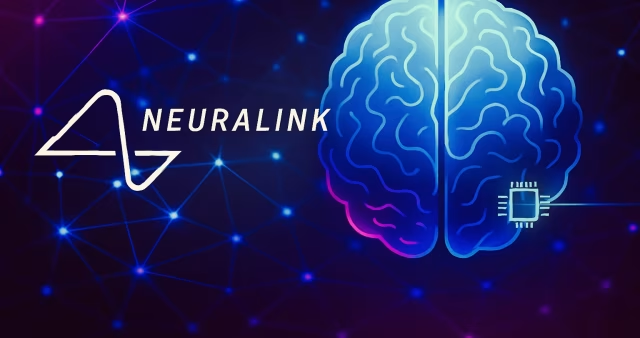
Elon Musk's Neuralink restores paralyzed patient's voice through artificial intelligence
Brad Smith, the third patient to receive a Neuralink brain implant and the first with amyotrophic lateral sclerosis (ALS), has reached a milestone: he can now communicate solely through his thoughts. Although he is nonverbal and uses a ventilator to breathe, Smith controls a computer with his mind, types, navigates apps and even speaks using a version of his voice cloned through artificial intelligence.
Neuralink's implant, called "Link," consists of 1,024 electrodes connected by very thin wires that are inserted into the motor cortex of the brain. The device connects to a MacBook Pro via Bluetooth, and by training the system to recognize neural signals, Smith has created personalized tools like a virtual keyboard and shortcuts for faster communication. To improve his typing speed, he has collaborated with Neuralink to develop a chat app that uses AI to suggest ready-made responses, which he selects simply by thinking. Notably, the AI-generated voice is based on recordings made before Smith lost the ability to speak, giving his communication a more personal feel. This development marks a major step forward for brain-computer interface technologies and opens up new horizons for helping people with severe motor disorders, offering them a new and more dignified way to interact with the world. Neuralink, the company founded by Elon Musk in 2016, aims to develop direct interfaces between the human brain and electronic devices. Through innovations in the miniaturization of electrodes and robotic surgeries, Neuralink aims not only to help patients with neurological disorders, but also to combine artificial intelligence with human intelligence in the future. The “Link” implant project is the first concrete step towards realizing this ambitious vision.
Neuralink's implant, called "Link," consists of 1,024 electrodes connected by very thin wires that are inserted into the motor cortex of the brain. The device connects to a MacBook Pro via Bluetooth, and by training the system to recognize neural signals, Smith has created personalized tools like a virtual keyboard and shortcuts for faster communication. To improve his typing speed, he has collaborated with Neuralink to develop a chat app that uses AI to suggest ready-made responses, which he selects simply by thinking. Notably, the AI-generated voice is based on recordings made before Smith lost the ability to speak, giving his communication a more personal feel. This development marks a major step forward for brain-computer interface technologies and opens up new horizons for helping people with severe motor disorders, offering them a new and more dignified way to interact with the world. Neuralink, the company founded by Elon Musk in 2016, aims to develop direct interfaces between the human brain and electronic devices. Through innovations in the miniaturization of electrodes and robotic surgeries, Neuralink aims not only to help patients with neurological disorders, but also to combine artificial intelligence with human intelligence in the future. The “Link” implant project is the first concrete step towards realizing this ambitious vision.

07
Apple moves to India: Indian factories prepare for mass production of iPhones
Apple has announced that it plans to move the assembly of iPhones sold in the United States from China to India, with the aim of completing this process by the end of 2026. This move comes in response to rising trade tensions and new tariffs that have been imposed between the US and China, including the 145% import tax on Chinese goods imposed by the US administration.
To meet demand in the US market, Apple plans to produce over 60 million iPhones per year in India, thus doubling the current production capacity in this country. The company is working closely with key suppliers such as Foxconn and Tata Electronics to increase production capacity, including increasing shipments to the US and expanding working hours at Indian factories.
While this strategy aims to reduce Apple's dependence on China for iPhone production, the company will continue to rely on China for components and assembly of other products, such as Macs and iPads. However, the move to India is not without challenges, including infrastructure constraints and the need to train a workforce.
The move represents a significant step in Apple's efforts to diversify its supply chain and reduce geopolitical risks, marking a major shift in its global manufacturing strategy.
To meet demand in the US market, Apple plans to produce over 60 million iPhones per year in India, thus doubling the current production capacity in this country. The company is working closely with key suppliers such as Foxconn and Tata Electronics to increase production capacity, including increasing shipments to the US and expanding working hours at Indian factories.
While this strategy aims to reduce Apple's dependence on China for iPhone production, the company will continue to rely on China for components and assembly of other products, such as Macs and iPads. However, the move to India is not without challenges, including infrastructure constraints and the need to train a workforce.
The move represents a significant step in Apple's efforts to diversify its supply chain and reduce geopolitical risks, marking a major shift in its global manufacturing strategy.

08
Adobe introduces new image generation models with Firefly
Adobe has launched new artificial intelligence models for generating images through the Firefly platform, along with a complete redesign of the web application. The goal is to provide users with a more powerful, flexible and collaborative experience in creating visual content. The new models offer higher image quality, more control over visual elements and faster and more efficient use.
The Firefly Image Model 4 model brings improvements in speed and resolution, generating images up to 2K with expanded options for styling and composition. Meanwhile, the Firefly Image Model 4 Ultra is designed for more detailed and complex scenes, with better arrangement of structures and fine elements. Both models are built on licensed, commercially-safe data, making them ideal for professional designers and creators.
In addition to the new models, Adobe also introduced a redesigned version of the Firefly web app, which now serves as a hub for all of the company's creative AI tools. Users can also access other AI models from OpenAI, Google, and other partner companies. Firefly Boards, a new visual collaboration tool, was also introduced, as well as plans for a mobile app that will bring the power of Firefly to iOS and Android devices. Meanwhile, Creative Cloud apps like Photoshop and Illustrator have received updates that include new AI-powered visual generation and intelligent processing features.
The Firefly Image Model 4 model brings improvements in speed and resolution, generating images up to 2K with expanded options for styling and composition. Meanwhile, the Firefly Image Model 4 Ultra is designed for more detailed and complex scenes, with better arrangement of structures and fine elements. Both models are built on licensed, commercially-safe data, making them ideal for professional designers and creators.
In addition to the new models, Adobe also introduced a redesigned version of the Firefly web app, which now serves as a hub for all of the company's creative AI tools. Users can also access other AI models from OpenAI, Google, and other partner companies. Firefly Boards, a new visual collaboration tool, was also introduced, as well as plans for a mobile app that will bring the power of Firefly to iOS and Android devices. Meanwhile, Creative Cloud apps like Photoshop and Illustrator have received updates that include new AI-powered visual generation and intelligent processing features.

09
OpenAI Ready to Buy Chrome if Google Is Forced to Sell It
Nick Turley from OpenAI stated that the company would be willing to buy the Chrome browser if it were to go on sale due to regulatory intervention. He emphasized that an integration of ChatGPT with Chrome would create an exceptional experience for users and would bring a new way of browsing the Internet based on artificial intelligence.
The idea of separating Chrome from Google has been proposed by the US Department of Justice as a way to break the company's dominance in the search and advertising markets. Although Google has been found guilty of violating antitrust laws, final decisions have not yet been made and the company has announced an appeal. For OpenAI, acquiring Chrome would mean control over one of the most powerful digital distribution platforms in the world.
If the court orders the sale of Chrome, this would represent a fundamental change in the technology industry. Such a move would weaken Google’s dominant position and give new competitors like OpenAI a golden opportunity to build a new ecosystem of users, led by AI. Although still hypothetical, this possibility clearly demonstrates OpenAI’s ambitions to play a key role in the future of the internet.
The idea of separating Chrome from Google has been proposed by the US Department of Justice as a way to break the company's dominance in the search and advertising markets. Although Google has been found guilty of violating antitrust laws, final decisions have not yet been made and the company has announced an appeal. For OpenAI, acquiring Chrome would mean control over one of the most powerful digital distribution platforms in the world.
If the court orders the sale of Chrome, this would represent a fundamental change in the technology industry. Such a move would weaken Google’s dominant position and give new competitors like OpenAI a golden opportunity to build a new ecosystem of users, led by AI. Although still hypothetical, this possibility clearly demonstrates OpenAI’s ambitions to play a key role in the future of the internet.

10
The Ethical Cost of Communication: When “Praying” Increases the Energy Bill
OpenAI CEO Sam Altman recently admitted that polite user interactions with ChatGPT—such as using the words “please” and “thank you”—are contributing to increased operational costs. Responding to a question on the X network (formerly Twitter) about the financial impact of these polite expressions, Altman said they cost “tens of millions of dollars.” That’s because each additional word in a query increases the number of “tokens” the model has to process, increasing the demand for computing resources and energy.
Each additional word in a query translates into more work for the data centers that power large AI models. These centers consume a huge amount of electricity, and when billions of such requests are sent every day, the impact becomes significant. If this energy doesn’t come from renewable sources, it increases pollution and carbon footprints. This has raised concerns about the environmental impact of our everyday digital behaviors, no matter how innocent they may seem.
However, Altman defends this additional cost as worthwhile, emphasizing the importance of having as natural and human-like conversations with AI as possible. Polite behavior not only improves the user experience, but also influences how AI responds—promoting cooperation and respect. Many people see politeness toward AI as a reflection of human norms, and for some, even an ethical stance toward technology.
Each additional word in a query translates into more work for the data centers that power large AI models. These centers consume a huge amount of electricity, and when billions of such requests are sent every day, the impact becomes significant. If this energy doesn’t come from renewable sources, it increases pollution and carbon footprints. This has raised concerns about the environmental impact of our everyday digital behaviors, no matter how innocent they may seem.
However, Altman defends this additional cost as worthwhile, emphasizing the importance of having as natural and human-like conversations with AI as possible. Polite behavior not only improves the user experience, but also influences how AI responds—promoting cooperation and respect. Many people see politeness toward AI as a reflection of human norms, and for some, even an ethical stance toward technology.