Technology
Monday, October 19, 2026
Innovation · Trends · Analysis

Artemis II Reaches Last Earth Orbit Ahead of Lunar Flight
Astronauts aboard Artemis II have successfully reached their final orbital position around Earth, marking a crucial milestone before setting course toward the Moon, according to NASA.
The crew, traveling inside the Orion spacecraft, entered a stable low Earth orbit following launch, where mission control teams conducted a series of system checks and trajectory alignments. This phase ensures that all onboard systems — including navigation, propulsion, and life support — are functioning as expected before committing to deep space travel.
The next step, known as the Translunar Injection (TLI), will involve a precisely timed engine burn that propels the spacecraft out of Earth’s orbit and onto a path toward the Moon. Engineers emphasize that this maneuver requires exact positioning and timing, as even minor deviations could significantly affect the mission trajectory.
“This is one of the most critical moments of the mission,” mission specialists noted, highlighting the need for precise orbital alignment before initiating the burn. The maneuver will accelerate Orion to speeds sufficient to escape Earth’s gravitational pull and begin its multi-day journey toward lunar space.
Unlike previous missions in the Artemis program, Artemis II is designed as a crewed test flight, carrying astronauts on a lunar flyby without landing. The mission will validate key systems and operational procedures ahead of future missions, including Artemis III, which aims to return humans to the lunar surface for the first time in decades.
The Artemis program represents NASA’s broader effort to establish a sustained human presence on the Moon and pave the way for future missions to Mars.
Further updates are expected as the crew prepares to execute the translunar injection burn in the coming hours.
The crew, traveling inside the Orion spacecraft, entered a stable low Earth orbit following launch, where mission control teams conducted a series of system checks and trajectory alignments. This phase ensures that all onboard systems — including navigation, propulsion, and life support — are functioning as expected before committing to deep space travel.
The next step, known as the Translunar Injection (TLI), will involve a precisely timed engine burn that propels the spacecraft out of Earth’s orbit and onto a path toward the Moon. Engineers emphasize that this maneuver requires exact positioning and timing, as even minor deviations could significantly affect the mission trajectory.
“This is one of the most critical moments of the mission,” mission specialists noted, highlighting the need for precise orbital alignment before initiating the burn. The maneuver will accelerate Orion to speeds sufficient to escape Earth’s gravitational pull and begin its multi-day journey toward lunar space.
Unlike previous missions in the Artemis program, Artemis II is designed as a crewed test flight, carrying astronauts on a lunar flyby without landing. The mission will validate key systems and operational procedures ahead of future missions, including Artemis III, which aims to return humans to the lunar surface for the first time in decades.
The Artemis program represents NASA’s broader effort to establish a sustained human presence on the Moon and pave the way for future missions to Mars.
Further updates are expected as the crew prepares to execute the translunar injection burn in the coming hours.
Ad space

Bitcoin Nears the End: Only 1 Million Left to Be Mined
The network of the cryptocurrency Bitcoin has reached an important historic milestone today, as the 20 millionth bitcoin has been mined, leaving only around 1 million more coins to be created in the future, according to a report from the blog of the crypto platform Kraken.
According to Kraken’s report, this means that more than 95% of all bitcoins that will ever exist are already in circulation. However, the remaining portion of coins will not be created quickly, as the mining process will continue for more than a century due to the mechanism known as “halving,” which gradually reduces the reward given to miners.
Bitcoin was created in 2009 by an anonymous person or group using the pseudonym Satoshi Nakamoto. From the beginning, the network’s code established a maximum limit of 21 million bitcoins that can ever exist, a rule embedded directly in its protocol.
According to the analysis published by Kraken, unlike traditional resources such as gold or fiat currencies, the supply of bitcoin cannot be increased by decisions of institutions or governments. The system operates through a global network of computers that follow the same rules and require consensus for any potential change to the protocol.
This mechanism makes the 21 million bitcoin limit practically immutable, since any attempt to modify it would require agreement among the network’s participants who would be directly affected by such a change. For this reason, according to industry experts, bitcoin is considered one of the digital assets with the most predictable supply in history.
The creation of new bitcoins occurs through mining, an activity in which specialized computers verify transactions on the network and add new blocks to the blockchain. As a reward for this process, miners receive newly issued bitcoins, but this reward is cut in half approximately every four years through the halving mechanism.
Because of this system, the rate at which new coins are created will continue to slow down until the maximum limit of 21 million bitcoins is reached, which is expected to occur around the year 2140.
Reaching the 20 million bitcoin milestone is considered by many analysts to be a symbolic moment that highlights the scarce nature of this cryptocurrency and the way its monetary policy is defined by code rather than institutional decisions.
This development comes more than 15 years after the creation of the Bitcoin network and, according to Kraken’s blog report, reinforces one of the project’s fundamental principles: a fixed and predictable supply of digital currency.
According to Kraken’s report, this means that more than 95% of all bitcoins that will ever exist are already in circulation. However, the remaining portion of coins will not be created quickly, as the mining process will continue for more than a century due to the mechanism known as “halving,” which gradually reduces the reward given to miners.
Bitcoin was created in 2009 by an anonymous person or group using the pseudonym Satoshi Nakamoto. From the beginning, the network’s code established a maximum limit of 21 million bitcoins that can ever exist, a rule embedded directly in its protocol.
According to the analysis published by Kraken, unlike traditional resources such as gold or fiat currencies, the supply of bitcoin cannot be increased by decisions of institutions or governments. The system operates through a global network of computers that follow the same rules and require consensus for any potential change to the protocol.
This mechanism makes the 21 million bitcoin limit practically immutable, since any attempt to modify it would require agreement among the network’s participants who would be directly affected by such a change. For this reason, according to industry experts, bitcoin is considered one of the digital assets with the most predictable supply in history.
The creation of new bitcoins occurs through mining, an activity in which specialized computers verify transactions on the network and add new blocks to the blockchain. As a reward for this process, miners receive newly issued bitcoins, but this reward is cut in half approximately every four years through the halving mechanism.
Because of this system, the rate at which new coins are created will continue to slow down until the maximum limit of 21 million bitcoins is reached, which is expected to occur around the year 2140.
Reaching the 20 million bitcoin milestone is considered by many analysts to be a symbolic moment that highlights the scarce nature of this cryptocurrency and the way its monetary policy is defined by code rather than institutional decisions.
This development comes more than 15 years after the creation of the Bitcoin network and, according to Kraken’s blog report, reinforces one of the project’s fundamental principles: a fixed and predictable supply of digital currency.
In this section

Technology
AI enters checkout: Google changes the way we shop online
Google has unveiled a new vision for the future of digital commerce, launching a series of new AI-powered tools that aim to transform the way consumers shop and how merchants sell online. The new initiative is known as agentic commerce – a form of commerce where AI not only recommends products but also acts autonomously to complete purchases on behalf of users.
At the heart of the announcement is the Universal Commerce Protocol (UCP), an open standard designed to connect platforms, merchants, payment providers and AI agents into a single ecosystem. This protocol was developed in collaboration with major e-commerce names such as Shopify, Etsy, Wayfair, Target and Walmart.
Full shopping within Gemini
Thanks to UCP, AI agents in Google Search (AI Mode) and in the Gemini app will be able to manage the entire shopping process from product search to payment without the user having to leave the platform.
For some select sellers in the US, Google has started testing checkout directly from search results, using data stored in Google Wallet and PayPal. Sellers always remain the responsible party for the transaction and have full control over the integration.
Another innovation is the Business Agent, a branded AI agent that allows users to communicate directly with companies through Search. This feature acts as a virtual sales consultant, answering questions about products, availability and purchase options. Brands like Lowe’s, Michael’s, Poshmark, and Reebok are expected to adopt this solution soon.
Google is also introducing new attributes in Merchant Center, designed to make products more understandable to AI systems. These include additional information such as answers to common questions, compatibility with accessories, or specific uses.
In the advertising field, Google is testing Direct Offers, a new format that allows sellers to offer discounts or exclusive benefits right when the user is ready to buy, within AI-driven experiences.
With this initiative, Google aims to move from the traditional click-and-buy model to purpose-driven shopping, where AI acts as an active intermediary between the consumer and the market. According to the company, this is a key step towards faster, more personal and more efficient commerce.
Recent developments show that agentic commerce is expected to play a central role in the future of global trade, fundamentally changing the relationship between technology, businesses and consumers.
At the heart of the announcement is the Universal Commerce Protocol (UCP), an open standard designed to connect platforms, merchants, payment providers and AI agents into a single ecosystem. This protocol was developed in collaboration with major e-commerce names such as Shopify, Etsy, Wayfair, Target and Walmart.
Full shopping within Gemini
Thanks to UCP, AI agents in Google Search (AI Mode) and in the Gemini app will be able to manage the entire shopping process from product search to payment without the user having to leave the platform.
For some select sellers in the US, Google has started testing checkout directly from search results, using data stored in Google Wallet and PayPal. Sellers always remain the responsible party for the transaction and have full control over the integration.
Another innovation is the Business Agent, a branded AI agent that allows users to communicate directly with companies through Search. This feature acts as a virtual sales consultant, answering questions about products, availability and purchase options. Brands like Lowe’s, Michael’s, Poshmark, and Reebok are expected to adopt this solution soon.
Google is also introducing new attributes in Merchant Center, designed to make products more understandable to AI systems. These include additional information such as answers to common questions, compatibility with accessories, or specific uses.
In the advertising field, Google is testing Direct Offers, a new format that allows sellers to offer discounts or exclusive benefits right when the user is ready to buy, within AI-driven experiences.
With this initiative, Google aims to move from the traditional click-and-buy model to purpose-driven shopping, where AI acts as an active intermediary between the consumer and the market. According to the company, this is a key step towards faster, more personal and more efficient commerce.
Recent developments show that agentic commerce is expected to play a central role in the future of global trade, fundamentally changing the relationship between technology, businesses and consumers.

Technology
Google launches Gemini 3: The intelligent agent that turns requests into concrete actions
Mountain View, CA - Google has just launched the latest version of its artificial intelligence app, Gemini 3, bringing significant improvements to the way users can interact with AI on their devices. With this update, Gemini becomes even smarter, more visual, and more capable of performing complex tasks autonomously.
At the heart of this update is Gemini 3, the most powerful model developed by Google to date. This model provides a new level of artificial intelligence, providing clearer, more structured, and more professionally formatted answers. It demonstrates deep multimodal understanding, which allows it to analyze and interpret mixed materials such as text with images or complex documents.
For example, users can upload a photo of a math problem and Gemini will not only understand the problem, but also solve it step by step. It can also summarize a web page or extract key content from a loaded document, making it easier to study and work.
Meanwhile, the application has received a more modern and customizable visual appearance. Two new experimental interfaces “Visual Layout” and “Dynamic View” aim to create dynamic experiences for users. “Visual Layout” creates magazine-style pages for various purposes, such as travel planning or informative reports, while “Dynamic View” builds interactive interfaces in real time for more advanced requests, such as art chronology or historical analysis.
But the main novelty of this update is the Gemini Agent, an intelligent assistant that goes beyond conversation and acts instead of the user. The agent is able to organize and sort emails, propose priority tasks, draft replies and even combine information from Google applications such as Drive, Calendar and Docs to help in real situations. Concrete example: you can ask it to find and book a rental car for you for a trip based on your personal details and a set budget.
Google ensures that the user continues to have full control over the agent's actions. Any important action, such as sending an email or making a payment, requires user confirmation to avoid errors or unintentional interference.
As for availability, Gemini 3 is globally accessible starting today within the Gemini app, and users can activate the new model from the “Model → Thinking” section. The advanced Gemini Agent feature will initially be available only to Google AI Ultra subscribers in the US, while students with a Google AI Pro subscription will be given one year of free access to the new update.
This update takes Google further towards transforming AI from a passive tool to an autonomous intelligent assistant, bringing a new dimension to the interaction between humans and technology. With Gemini 3, AI is no longer just a conversationalist but a collaborator that can plan, analyze and take action intelligently and confidently.
At the heart of this update is Gemini 3, the most powerful model developed by Google to date. This model provides a new level of artificial intelligence, providing clearer, more structured, and more professionally formatted answers. It demonstrates deep multimodal understanding, which allows it to analyze and interpret mixed materials such as text with images or complex documents.
For example, users can upload a photo of a math problem and Gemini will not only understand the problem, but also solve it step by step. It can also summarize a web page or extract key content from a loaded document, making it easier to study and work.
Meanwhile, the application has received a more modern and customizable visual appearance. Two new experimental interfaces “Visual Layout” and “Dynamic View” aim to create dynamic experiences for users. “Visual Layout” creates magazine-style pages for various purposes, such as travel planning or informative reports, while “Dynamic View” builds interactive interfaces in real time for more advanced requests, such as art chronology or historical analysis.
But the main novelty of this update is the Gemini Agent, an intelligent assistant that goes beyond conversation and acts instead of the user. The agent is able to organize and sort emails, propose priority tasks, draft replies and even combine information from Google applications such as Drive, Calendar and Docs to help in real situations. Concrete example: you can ask it to find and book a rental car for you for a trip based on your personal details and a set budget.
Google ensures that the user continues to have full control over the agent's actions. Any important action, such as sending an email or making a payment, requires user confirmation to avoid errors or unintentional interference.
As for availability, Gemini 3 is globally accessible starting today within the Gemini app, and users can activate the new model from the “Model → Thinking” section. The advanced Gemini Agent feature will initially be available only to Google AI Ultra subscribers in the US, while students with a Google AI Pro subscription will be given one year of free access to the new update.
This update takes Google further towards transforming AI from a passive tool to an autonomous intelligent assistant, bringing a new dimension to the interaction between humans and technology. With Gemini 3, AI is no longer just a conversationalist but a collaborator that can plan, analyze and take action intelligently and confidently.
Technology
OpenAI Brings Atlas: The Intelligent Browser with ChatGPT to macOS
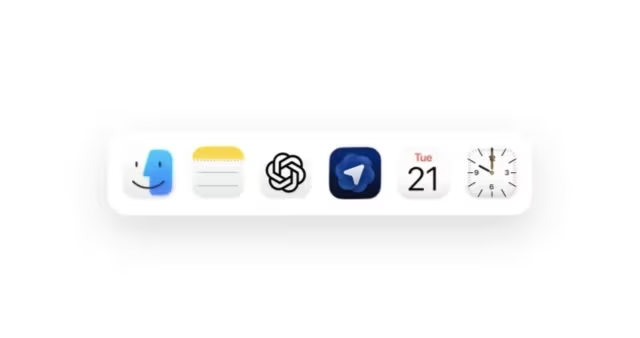
OpenAI has introduced ChatGPT Atlas, a new version of its intelligent platform that marks a major step towards full web interaction. Unlike traditional versions of ChatGPT that operate as a standalone website or app, Atlas is designed to stay with the user wherever they are on the web, helping them while browsing, searching, or working on documents. Currently, the app is available for macOS and will initially be offered to Plus, Pro, and Business users.
Essentially, ChatGPT Atlas functions as a personal assistant within the browser. With a sidebar that can be opened on any page, users can ask Atlas to summarize the content of an article, compare products, or analyze data from any site they are visiting. It can remember details from previous sessions, but it also offers complete control: the user decides what ChatGPT can remember and when to clear this memory. This is an important balance between intelligent functionality and privacy.
One of the most important innovations is “Agent Mode”, which allows ChatGPT to interact with websites on behalf of the user, always under their control. This means that Atlas can help complete tasks from start to finish, for example, search for and book a trip, or find and compare offers online. Although this feature is still in the testing phase, it shows the new direction of the development of artificial intelligence as an active collaborator, not just a response tool.
As for security and privacy, OpenAI has emphasized that users will have full control over what ChatGPT sees and remembers. They can limit access to specific sites, use Incognito mode, and clear browsing history at any time. These measures come at a time when concerns about data storage and online tracking are higher than ever.
Currently, ChatGPT Atlas is only available for macOS users, but OpenAI is expected to expand support to Windows and other platforms soon. The company has not yet announced which browsers will be supported initially, but it is expected that the integration will start with Safari and then expand to Chrome or Edge.
The launch of ChatGPT Atlas signals a major change in the way users interact with artificial intelligence. From a chatbot that opens on the page, ChatGPT is transforming into an assistant that follows you every step of the way, making it part of your digital everyday life. For users who work a lot on the Internet, this approach could change the way they search for information, write, analyze or communicate online.
X/OpenAi
Essentially, ChatGPT Atlas functions as a personal assistant within the browser. With a sidebar that can be opened on any page, users can ask Atlas to summarize the content of an article, compare products, or analyze data from any site they are visiting. It can remember details from previous sessions, but it also offers complete control: the user decides what ChatGPT can remember and when to clear this memory. This is an important balance between intelligent functionality and privacy.
One of the most important innovations is “Agent Mode”, which allows ChatGPT to interact with websites on behalf of the user, always under their control. This means that Atlas can help complete tasks from start to finish, for example, search for and book a trip, or find and compare offers online. Although this feature is still in the testing phase, it shows the new direction of the development of artificial intelligence as an active collaborator, not just a response tool.
As for security and privacy, OpenAI has emphasized that users will have full control over what ChatGPT sees and remembers. They can limit access to specific sites, use Incognito mode, and clear browsing history at any time. These measures come at a time when concerns about data storage and online tracking are higher than ever.
Currently, ChatGPT Atlas is only available for macOS users, but OpenAI is expected to expand support to Windows and other platforms soon. The company has not yet announced which browsers will be supported initially, but it is expected that the integration will start with Safari and then expand to Chrome or Edge.
The launch of ChatGPT Atlas signals a major change in the way users interact with artificial intelligence. From a chatbot that opens on the page, ChatGPT is transforming into an assistant that follows you every step of the way, making it part of your digital everyday life. For users who work a lot on the Internet, this approach could change the way they search for information, write, analyze or communicate online.
X/OpenAi
More headlines

06
Apple sets a new design standard with the iPhone Air
Apple has officially introduced iPhone Air, the lightest and thinnest iPhone to date, setting a new design standard for the company. At just 5.6 millimeters thin and weighing about 165 grams, the new device almost disappears in the hand, while offering high-end performance. Apple says this model rewrites expectations for an ultra-thin smartphone without compromising on power or features.
iPhone Air is built with polished, shiny grade 5 titanium, a material known for its strength and lightness, while being protected by new Ceramic Shield 2 glass on both sides. This improved glass offers up to three times more scratch resistance on the front and up to four times more crack resistance on the back than previous models.
On the front, the device comes with a 6.5-inch Super Retina XDR display with ProMotion technology, which supports refresh rates up to 120 Hz. The display adjusts to 1 Hz when necessary to save battery life, while outdoor visibility has been improved at maximum brightness. Apple claims that outdoor contrast is twice as high as on previous iPhones, making the display visible even in direct sunlight.
Inside, the iPhone Air is powered by the new A19 Pro chip, which Apple calls the fastest processor in a smartphone. Together with the C1X modem and redesigned architecture, the chip brings a big leap forward in efficiency and speed. According to Apple, these improvements provide consistent all-day battery life despite the thinner body, addressing concerns that the thin design could negatively affect battery life.
The iPhone Air is also equipped with an advanced camera system. On the back is a 48 MP Fusion main camera with 2× telephoto capabilities, while on the front there is an 18 MP Center Stage camera for selfies and video calls. Apple has added new software improvements such as Camera Control for instant access to key functions and smart editing tools, including the “Clean Up” option in the Photos app.
Among other features, the Action Button, first introduced on the Pro models, allows for customization of quick functions. The device supports MagSafe and Apple's ecosystem of accessories, while running iOS enriched with new artificial intelligence branded as Apple Intelligence. Like the last models, this model is eSIM-only, without a physical SIM card slot, requiring support from carriers that offer eSIM.
Pre-orders for the iPhone Air start on September 12, while official sales begin on September 19. The phone will be available in four colors: Space Black, Cloud White, Light Gold, and Sky Blue. Prices and trade-in offers vary by region and carrier, but Apple positions this model as a premium option for users looking for advanced technology in a lightweight format.
With the launch of the iPhone Air, Apple sends a clear message: performance and portability do not have to be in conflict. By combining professional-grade features with an ultra-thin body, the company believes that consumers will welcome a device that is as powerful as it is elegant.
iPhone Air is built with polished, shiny grade 5 titanium, a material known for its strength and lightness, while being protected by new Ceramic Shield 2 glass on both sides. This improved glass offers up to three times more scratch resistance on the front and up to four times more crack resistance on the back than previous models.
On the front, the device comes with a 6.5-inch Super Retina XDR display with ProMotion technology, which supports refresh rates up to 120 Hz. The display adjusts to 1 Hz when necessary to save battery life, while outdoor visibility has been improved at maximum brightness. Apple claims that outdoor contrast is twice as high as on previous iPhones, making the display visible even in direct sunlight.
Inside, the iPhone Air is powered by the new A19 Pro chip, which Apple calls the fastest processor in a smartphone. Together with the C1X modem and redesigned architecture, the chip brings a big leap forward in efficiency and speed. According to Apple, these improvements provide consistent all-day battery life despite the thinner body, addressing concerns that the thin design could negatively affect battery life.
The iPhone Air is also equipped with an advanced camera system. On the back is a 48 MP Fusion main camera with 2× telephoto capabilities, while on the front there is an 18 MP Center Stage camera for selfies and video calls. Apple has added new software improvements such as Camera Control for instant access to key functions and smart editing tools, including the “Clean Up” option in the Photos app.
Among other features, the Action Button, first introduced on the Pro models, allows for customization of quick functions. The device supports MagSafe and Apple's ecosystem of accessories, while running iOS enriched with new artificial intelligence branded as Apple Intelligence. Like the last models, this model is eSIM-only, without a physical SIM card slot, requiring support from carriers that offer eSIM.
Pre-orders for the iPhone Air start on September 12, while official sales begin on September 19. The phone will be available in four colors: Space Black, Cloud White, Light Gold, and Sky Blue. Prices and trade-in offers vary by region and carrier, but Apple positions this model as a premium option for users looking for advanced technology in a lightweight format.
With the launch of the iPhone Air, Apple sends a clear message: performance and portability do not have to be in conflict. By combining professional-grade features with an ultra-thin body, the company believes that consumers will welcome a device that is as powerful as it is elegant.

07
Researchers discover why artificial intelligence often invents facts
A new research paper from OpenAI reveals why “hallucinations” occur in LLMs. The authors argue that, in fact, they are a natural consequence of the way these systems are trained and evaluated.
Even when the training data is perfectly accurate, the objectives and measurement methods in artificial intelligence development push the model to make possible but incorrect assumptions, rather than acknowledge uncertainty.
The researchers frame hallucination as a common classification problem. Generative errors in LLMs, they explain, are very similar to classification errors in supervised learning. When the system is forced to always give an answer, it is structurally incentivized to produce confident statements even when they are incorrect.
Assessment practices further compound this problem. Most tests are based on binary accuracy metrics, where an answer is either correct or incorrect, with no reward for a “I don’t know.”
In this setup, hesitation is not rewarded, while guessing sometimes earns points. The authors point out that this system resembles the logic of multiple-choice exams: when blank answers earn zero points, rational students choose to guess. Formal analysis shows that, under these conditions, the expected outcome of a guess is always higher than that of hesitation.
To illustrate the mechanism of this stimulation, the team proposed a simplified “Arbitrary Facts” model. In this case, each question had a correct answer chosen at random, so there was no model to train.
The researchers showed that the number of “single facts” (which appeared only once in training) sets a lower limit on the rate of hallucinations. When facts are rare, the model faces high uncertainty and is practically forced to guess.
The study also highlights several other factors that contribute to hallucinations. A model with insufficient capacity can fail to understand patterns even when they exist, producing errors.
The difference in distribution between training and testing questions often leads to failures. Some questions are inherently difficult, and incorrect or noisy data directly produce incorrect results.
The authors' main recommendation is to review how artificial intelligence performance is measured.
Instead of penalizing hesitation, evaluation frameworks should reward models when they do not provide answers if they are not sure, and impose stronger penalties for incorrect answers given with high confidence. One proposal includes explicit confidence thresholds, where models should respond only when confidence exceeds a certain level, with graduated penalties for errors. Such a system would encourage models to say “I don’t know” more often when necessary. The study’s conclusions are that hallucinations are not unexplained anomalies, but predictable outcomes of the current training and testing environment.
Even when the training data is perfectly accurate, the objectives and measurement methods in artificial intelligence development push the model to make possible but incorrect assumptions, rather than acknowledge uncertainty.
The researchers frame hallucination as a common classification problem. Generative errors in LLMs, they explain, are very similar to classification errors in supervised learning. When the system is forced to always give an answer, it is structurally incentivized to produce confident statements even when they are incorrect.
Assessment practices further compound this problem. Most tests are based on binary accuracy metrics, where an answer is either correct or incorrect, with no reward for a “I don’t know.”
In this setup, hesitation is not rewarded, while guessing sometimes earns points. The authors point out that this system resembles the logic of multiple-choice exams: when blank answers earn zero points, rational students choose to guess. Formal analysis shows that, under these conditions, the expected outcome of a guess is always higher than that of hesitation.
To illustrate the mechanism of this stimulation, the team proposed a simplified “Arbitrary Facts” model. In this case, each question had a correct answer chosen at random, so there was no model to train.
The researchers showed that the number of “single facts” (which appeared only once in training) sets a lower limit on the rate of hallucinations. When facts are rare, the model faces high uncertainty and is practically forced to guess.
The study also highlights several other factors that contribute to hallucinations. A model with insufficient capacity can fail to understand patterns even when they exist, producing errors.
The difference in distribution between training and testing questions often leads to failures. Some questions are inherently difficult, and incorrect or noisy data directly produce incorrect results.
The authors' main recommendation is to review how artificial intelligence performance is measured.
Instead of penalizing hesitation, evaluation frameworks should reward models when they do not provide answers if they are not sure, and impose stronger penalties for incorrect answers given with high confidence. One proposal includes explicit confidence thresholds, where models should respond only when confidence exceeds a certain level, with graduated penalties for errors. Such a system would encourage models to say “I don’t know” more often when necessary. The study’s conclusions are that hallucinations are not unexplained anomalies, but predictable outcomes of the current training and testing environment.

08
GPT-5 Launched: The Model That Brings the World Closer to Artificial General Intelligence
OpenAI has officially launched GPT-5, the latest generation of its artificial intelligence model, making it available to all ChatGPT users. The new version offers improved skills in writing, programming, math, health, and finance, with expert-level performance and advanced multimodal processing across text, images, audio, and video.
The company's CEO, Sam Altman, described GPT-5 as "a conversation with a PhD-level expert." The model includes a new deep reasoning system and has significantly reduced errors known as "hallucinations" compared to previous versions.
Users can choose different personalities to interact with and, through advanced subscriptions, integrate GPT-5 with services like Gmail and Google Calendar. Free subscribers have limited access, while Pro users get unlimited use and the GPT-5 Pro version for complex tasks.
The launch of GPT-5 is seen as a major step towards general artificial intelligence, with rapid integrations into Microsoft platforms and other business tools.
The company's CEO, Sam Altman, described GPT-5 as "a conversation with a PhD-level expert." The model includes a new deep reasoning system and has significantly reduced errors known as "hallucinations" compared to previous versions.
Users can choose different personalities to interact with and, through advanced subscriptions, integrate GPT-5 with services like Gmail and Google Calendar. Free subscribers have limited access, while Pro users get unlimited use and the GPT-5 Pro version for complex tasks.
The launch of GPT-5 is seen as a major step towards general artificial intelligence, with rapid integrations into Microsoft platforms and other business tools.

09
OpenAI and NVIDIA break record: 1.5 million tokens per second with open-licensed AI models
OpenAI and NVIDIA have joined forces to release two powerful artificial intelligence models with the GPT‑OSS‑120B and GPT‑OSS‑20B, marking a key moment in democratizing access to advanced AI. These models are designed to support a wide range of applications in content generation, reasoning, healthcare, industrial manufacturing, and more. Distributed under the Apache 2.0 license, the models are free for commercial and research use, providing developers, enterprises, governments, and startups with the tools to build transformative AI-based solutions.
The GPT‑OSS models are trained on NVIDIA H100 GPUs and optimized to run on NVIDIA’s global CUDA platform, which powers hundreds of millions of GPUs in the cloud, personal computers, and workstations worldwide. This strategic alignment ensures that developers around the globe can integrate these models into their existing infrastructure.
At the heart of this advancement is NVIDIA’s Blackwell architecture, purpose-built for high-throughput AI inference. The GB200 NVL72 mainframe achieves an unprecedented 1.5 million tokens per second when running the GPT‑OSS‑120B model, making it one of the most powerful inference platforms in the world. Blackwell brings innovations like NVFP44-bit precision, which enables extremely efficient execution with high precision, while significantly reducing power consumption and memory requirements, a giant step towards real-time use of models with trillions of parameters.
This collaboration also reflects a long-standing partnership between OpenAI and NVIDIA, dating back to 2016, when NVIDIA founder Jensen Huang personally delivered the first DGX-1 supercomputer to OpenAI’s headquarters in San Francisco. Since then, the two companies have collaborated on some of the world’s most ambitious AI training. Today’s release builds on this legacy, bringing cutting-edge AI capabilities to millions of developers globally, supported by an ecosystem of over 6.5 million developers in more than 250 countries.
Fundamentally, the release of GPT‑OSS represents a significant step towards making advanced AI more transparent, efficient, and accessible to everyone. With scalable infrastructure, open licensing, and broad hardware support, OpenAI and NVIDIA are not only accelerating the pace of innovation, but also building the foundation for the next industrial revolution driven by open, accountable, and high-performance AI.
The GPT‑OSS models are trained on NVIDIA H100 GPUs and optimized to run on NVIDIA’s global CUDA platform, which powers hundreds of millions of GPUs in the cloud, personal computers, and workstations worldwide. This strategic alignment ensures that developers around the globe can integrate these models into their existing infrastructure.
At the heart of this advancement is NVIDIA’s Blackwell architecture, purpose-built for high-throughput AI inference. The GB200 NVL72 mainframe achieves an unprecedented 1.5 million tokens per second when running the GPT‑OSS‑120B model, making it one of the most powerful inference platforms in the world. Blackwell brings innovations like NVFP44-bit precision, which enables extremely efficient execution with high precision, while significantly reducing power consumption and memory requirements, a giant step towards real-time use of models with trillions of parameters.
This collaboration also reflects a long-standing partnership between OpenAI and NVIDIA, dating back to 2016, when NVIDIA founder Jensen Huang personally delivered the first DGX-1 supercomputer to OpenAI’s headquarters in San Francisco. Since then, the two companies have collaborated on some of the world’s most ambitious AI training. Today’s release builds on this legacy, bringing cutting-edge AI capabilities to millions of developers globally, supported by an ecosystem of over 6.5 million developers in more than 250 countries.
Fundamentally, the release of GPT‑OSS represents a significant step towards making advanced AI more transparent, efficient, and accessible to everyone. With scalable infrastructure, open licensing, and broad hardware support, OpenAI and NVIDIA are not only accelerating the pace of innovation, but also building the foundation for the next industrial revolution driven by open, accountable, and high-performance AI.

10
Apple Pay now available in Kosovo
The Central Bank of the Republic of Kosovo (CBK) has officially announced that the advanced contactless payment service, Apple Pay, is now available in Kosovo, marking a key moment in the process of digitalizing payments and integrating the Kosovo financial market into global standards.
Through this development, citizens and businesses in Kosovo will be able to make secure, fast and modern payments through Apple devices such as iPhone and Apple Watch. Banks and financial institutions in the country will be able to link their cards to the Apple Pay platform, depending on individual agreements and relevant technical integrations.
The CBK considers this an important step towards modernizing the payment system, increasing financial inclusion and fulfilling the objectives of the Strategic Plan 2024–2028. According to the institution, after the integration of Google Pay, the addition of Apple Pay reinforces the approach towards the internationalization of financial services and approximation with European standards for digital payments.
In this regard, the CBK also commemorates the meeting of May 2025 with senior representatives of the Apple company, where the commitment to creating favorable conditions for modern financial services in Kosovo was reconfirmed.
This success is the result of close cooperation between the CBK, the banking sector and international partners, with particular emphasis on the Embassy of the United States of America.
Through this development, citizens and businesses in Kosovo will be able to make secure, fast and modern payments through Apple devices such as iPhone and Apple Watch. Banks and financial institutions in the country will be able to link their cards to the Apple Pay platform, depending on individual agreements and relevant technical integrations.
The CBK considers this an important step towards modernizing the payment system, increasing financial inclusion and fulfilling the objectives of the Strategic Plan 2024–2028. According to the institution, after the integration of Google Pay, the addition of Apple Pay reinforces the approach towards the internationalization of financial services and approximation with European standards for digital payments.
In this regard, the CBK also commemorates the meeting of May 2025 with senior representatives of the Apple company, where the commitment to creating favorable conditions for modern financial services in Kosovo was reconfirmed.
This success is the result of close cooperation between the CBK, the banking sector and international partners, with particular emphasis on the Embassy of the United States of America.