Technology
Monday, October 19, 2026
Innovation · Trends · Analysis

Elon Musk Discusses Use of Blockchain Technology in New Department of Government Efficiency
In a bold move to boost technological innovation in government, Elon Musk is reportedly in talks to use blockchain technology in the new Department of Government Efficiency, Bloomberg reports. The talks are about using blockchain to streamline government processes, reduce bureaucracy and improve transparency in the delivery of public services. Musk, known for promoting advanced technologies, appears to be looking to use his expertise to modernize federal operations. The move signals the administration’s willingness to embrace the digital asset industry, following regulatory discussions on cryptocurrencies and the adoption of blockchain technology. Although no official announcement has been made yet, the potential partnership between the private sector and government could set a new precedent for the role of technology in governance.
Ad space

“Operator” Agent for performing online tasks from OpenAI
OpenAI has introduced Operator, an advanced artificial intelligence agent that can independently navigate a web browser to perform tasks such as booking travel accommodations, making restaurant reservations, and making online purchases. The feature is currently in beta and available exclusively to users in the US with ChatGPT’s Pro subscription. OpenAI plans to expand access to Plus, Team, and Enterprise plan users, with the goal of integrating Operator into all ChatGPT customers in the future. Operator is accessible via operator.chatgpt.com, and is designed to integrate seamlessly with the ChatGPT ecosystem as development continues. The agent offers users the ability to automate various tasks through intuitive categories such as shopping, deliveries, restaurants, and travel, making it easier to manage complex online activities. However, international expansion may be slower in some regions, including Europe, due to regulatory challenges. “Operator will be coming to other countries soon,” OpenAI CEO Sam Altman said during a live stream, adding that Europe “will have to wait longer, unfortunately.” Despite these delays, the launch of Operator marks an important step for OpenAI towards delivering innovative solutions for automating digital tasks, bringing a new level of ease and efficiency to online interactions.
In this section

Technology
Stargate AI: Trump's $500 Billion Project for US Technological Dominance
President Donald Trump has unveiled the Stargate AI project, an initiative to strengthen the US artificial intelligence infrastructure. With a planned investment of up to $500 billion over the next four years, the project will be implemented in collaboration with companies such as OpenAI, SoftBank and Oracle. The investment aims to create over 100,000 new jobs and ensure that technological advances remain within the US. The announcement of this initiative caused a positive reaction in the stock market, with technology companies such as Oracle, Nvidia and Arm Holdings recording significant increases. In addition to being an economically powerful project, Stargate AI underlines the administration’s commitment to maintaining America’s global lead in AI technology, positioning the country as a leader in this field. During his speech, Trump stated that the project is a strategic response to global competition, especially from China and other countries.

Technology
United Kingdom with Digital Driver's Licenses
The UK government is set to introduce digital driver’s licenses that can be accessed via mobile phones, in a bid to modernise public services and simplify the process of verifying identity. These digital licenses will be available through a new government app, allowing users to use their phones as a means of identification in a variety of situations, such as buying alcohol, voting and travelling within the country. In the meantime, traditional physical licenses will continue to be issued, and participation in the digital scheme is voluntary. The app is expected to include strong security measures, such as biometrics and multi-factor authentication, to protect personal data. The government is also exploring the possibility of integrating other services into the app, such as paying taxes and proving the right to work. The initiative puts the UK in line with countries such as Australia, Iceland, Denmark and Norway, which have already implemented digital driver’s licenses.

Technology
TikTok Will Be Banned If It's Not Sold by January 19th!
On January 17, 2025, the United States Supreme Court unanimously ruled that ByteDance, the Chinese company that owns TikTok, must sell the app by January 19, 2025, or the app will be banned in the United States.  President Joe Biden has decided not to extend the sale deadline, leaving the decision to the incoming administration of President-elect Donald Trump.  Meanwhile, reports have emerged that Chinese officials are considering selling TikTok to Elon Musk or another eligible entrepreneur to avoid a ban on the app in the United States.  This situation has prompted American users to seek alternatives, leading to the rise in popularity of the RedNote app (known as Xiaohongshu in China), which has become the most downloaded iPhone app in the United States. The Supreme Court's decision and the situation that followed have sparked intense debates about privacy, national security, and freedom of expression, raising new questions about the future of Chinese technology in the US.
More headlines

06
Capital Towards Modernization: Pristina with Digital Traffic Fines
A historic agreement was signed today between the Kosovo Police, the Kosovo Post and the Municipality of Pristina for the implementation of digital traffic fines. This innovative project is expected to bring significant improvements in road safety and order in the capital, marking an important step towards the modernization and digitalization of public services. This modern system aims not only to more effectively supervise and regulate traffic, but also to minimize violations and violations of rules. Through a more efficient and transparent approach, digital fines will help reduce violations, while citizens and institutions will benefit from a simplified and automated process. Digital fines are an internationally recognized innovation that has transformed the way traffic is managed. Instead of traditional systems, which depend on manual intervention, technologies such as traffic cameras and online databases are used to automatically record and punish violations. This method increases transparency and reduces the possibilities for abuse or bureaucratic delays. Digital fine systems have numerous benefits, including better data management and accurate documentation of violations in real time. Citizens receive instant notifications and have the opportunity to pay fines through online platforms, avoiding tedious manual processes. At the same time, these systems help increase public revenues, providing more funds for investments in road safety and modern infrastructure.
07
Meta Suspends Fact-Checking: Freedom of Expression or Danger of Disinformation?
Meta has announced the end of its third-party fact-checking programs on its Facebook, Instagram, and Threads platforms. In its place, the company plans to implement a user-based system similar to X’s (formerly Twitter’s) “Community Notes,” where users can add context or corrections to posts. According to CEO Mark Zuckerberg, the move is intended to reduce censorship and promote freedom of expression. He has expressed concerns that external fact-checkers have been “too politically biased” and have eroded trust, especially in the United States. Reactions to the change have been mixed. Supporters, including X owner Elon Musk, have praised the approach to user-moderated content. Meanwhile, critics, including fact-checking organizations and cybersecurity advocates, warn that it could lead to a rise in misinformation and harmful content on Meta’s platforms. Meta also plans to move its content moderation teams from California to Texas to address concerns about potential bias. Meanwhile, the company has announced that it intends to cooperate with the administration of President-elect Donald Trump.

08
Google DeepMind: Generative models that simulate the real world
Google DeepMind has announced the creation of a new team to develop generative artificial intelligence (AI) models that can simulate the physical world. Tim Brooks, one of the former leaders of OpenAI’s Sora video generator, will lead the initiative, which aims to tackle complex challenges in fields such as robotics, climate modeling, and interactive media. In a post on X, Brooks described the team’s mission as building “massive generative models that simulate the world” and invited experts to join the ambitious effort. The new team will collaborate with existing Google AI projects, including Gemini, Veo, and Genie. Gemini is Google’s main AI model for tasks such as text generation and image analysis, while Veo specializes in creating videos and Genie in generating realistic 3D environments. By combining these technologies, Brooks' team aims to scale AI models to unprecedented levels and create tools for real-time interactions and simulations. These developments are seen as important steps towards achieving artificial general intelligence (AGI), AI that can solve problems at a human level.
09
Italy in Talks with SpaceX: $1.6 Billion for Secure Satellite Communications
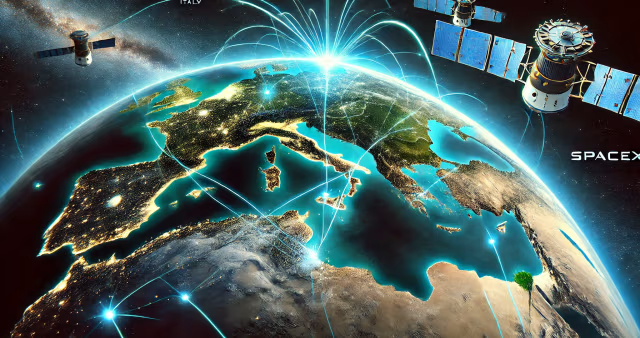
Italy is in talks with Elon Musk’s SpaceX, Bloomberg News reports, for a 1.5 billion euro (about $1.6 billion) deal that includes providing telecommunications security services to the Italian government. The project aims to significantly improve Italy’s secure communications infrastructure with advanced services, including encrypting government phone and internet communications and creating secure channels for the Italian government. The project is part of Italy’s broader strategy to strengthen its cybersecurity infrastructure and address growing challenges in the sector.

10
Apple TV+ Free This Weekend
Apple has announced that its streaming platform, Apple TV+, will be free for users this weekend, from January 3 to 5. The offer includes full access to the service’s premium content, including popular series, exclusive movies, and acclaimed documentaries. The promotion is part of the company’s efforts to attract new users and allow them to explore its rich catalog without any upfront payment. According to the company, Apple TV+ will be free on any device where the service is available, and the only thing required for access is an Apple ID. Currently, Apple TV+ costs $9.99 per month and allows up to six members of a Family Sharing group to share a single subscription to watch content. After the free weekend, users can choose to subscribe to continue watching popular series like “Ted Lasso,” “The Morning Show,” and “Foundation.”