Technology
Monday, October 19, 2026
Innovation · Trends · Analysis

Google accelerates quantum research with Gemini 4 Argon model
Google has introduced Gemini 4 Argon, its newest artificial intelligence model, developed to handle complex tasks in programming, scientific research, finance, law, and cybersecurity. The model is designed to reason in an advanced manner and to carry out processes that require many steps and long time to complete.
One of the main innovations is the increase of the text limit that the model can generate in a single response, from 64 thousand to 1 million tokens. This expansion enables it to handle more complex problems, perform deeper analyses, and execute long tasks without needing to split them into many separate processes.
The model also includes advanced capabilities for research in quantum physics, assisting in the analysis of complex systems, the development of quantum algorithms, and the solving of mathematical problems related to this field. These capabilities can support scientific research and the development of future quantum computing technologies.
According to Google, Gemini 4 Argon is already being used within the company for the development and improvement of computer programs. Among the projects where it is being applied is the migration of large systems from C and C++ languages to Rust, including parts of the Fuchsia operating system. The model has also been developed to autonomously identify, verify, and correct security vulnerabilities in computer programs.
In performance tests, the model has shown competitive results against advanced models from OpenAI and Anthropic, especially in programming, professional tasks, and cybersecurity. However, the results vary depending on the type of testing and do not demonstrate superiority in every area.
Currently, Gemini 4 Argon is available only to a selected group of cybersecurity specialists through the Fairwind program. Google has announced that access will be expanded gradually, initially for paying API customers and Google AI Ultra subscribers, before the model becomes more widely available.
The initial price will be $2 for one million input tokens and $10 for one million output tokens. After the promotional period ends, these prices will double. Google has not yet set a date for the model's general launch.
One of the main innovations is the increase of the text limit that the model can generate in a single response, from 64 thousand to 1 million tokens. This expansion enables it to handle more complex problems, perform deeper analyses, and execute long tasks without needing to split them into many separate processes.
The model also includes advanced capabilities for research in quantum physics, assisting in the analysis of complex systems, the development of quantum algorithms, and the solving of mathematical problems related to this field. These capabilities can support scientific research and the development of future quantum computing technologies.
According to Google, Gemini 4 Argon is already being used within the company for the development and improvement of computer programs. Among the projects where it is being applied is the migration of large systems from C and C++ languages to Rust, including parts of the Fuchsia operating system. The model has also been developed to autonomously identify, verify, and correct security vulnerabilities in computer programs.
In performance tests, the model has shown competitive results against advanced models from OpenAI and Anthropic, especially in programming, professional tasks, and cybersecurity. However, the results vary depending on the type of testing and do not demonstrate superiority in every area.
Currently, Gemini 4 Argon is available only to a selected group of cybersecurity specialists through the Fairwind program. Google has announced that access will be expanded gradually, initially for paying API customers and Google AI Ultra subscribers, before the model becomes more widely available.
The initial price will be $2 for one million input tokens and $10 for one million output tokens. After the promotional period ends, these prices will double. Google has not yet set a date for the model's general launch.
Ad space

OpenAI unveils GPT-6 Astra, the model that can take on full tasks
OpenAI has introduced GPT-6 Astra, the new artificial intelligence model that the company describes as its most intelligent and advanced model to date. Astra brings major improvements in programming, autonomous computer use, scientific research, cybersecurity, and the execution of complex professional tasks.
One of the main changes is Astra's ability to carry out long, multi-step processes. The model can work with browsers, programs, and various tools, fill out forms, update data, organize calendars, develop applications, and analyze data, requiring less user intervention.
OpenAI says that GPT-6 Astra achieves 99.9% on ARC-AGI-3, an advanced test for reasoning and adapting to new problems. OpenAI rates Astra as its best model to date for software engineering.
The capabilities in cybersecurity are particularly powerful. Astra achieved 100% on ExploitBench, while OpenAI has classified the model at the “Critical” level for cyber capabilities. For this reason, the most advanced cybersecurity functions will have more restricted access and additional protective measures.
GPT-6 Astra supports a context window of 1,050,000 tokens and up to 128,000 output tokens, making it suitable for analyses of very large documents and projects. The model also supports internet search, file search, image generation, code execution, computer usage, and MCP integrations.
In the API, the standard price is $10 per million input tokens and $50 per million output tokens. OpenAI also offers a Fast mode, up to twice as fast, at double the standard price.
Beyond performance, the company says it has significantly invested in the model's ability to respect the boundaries of the given task.
This is especially important as artificial intelligence models transition from chatbots that simply provide answers to agents that can autonomously take actions on a computer.
GPT-6 Astra is initially being rolled out to a limited number of organizations. OpenAI says that in the coming days the model will become available to ChatGPT Plus, Pro, Business, and Enterprise users, as well as through OpenAI's API, Microsoft Azure, and AWS Bedrock.
With Astra, OpenAI aims for a step beyond traditional conversational models: a system that not only reasons and generates content, but can increasingly autonomously carry out complex digital processes from start to finish.
One of the main changes is Astra's ability to carry out long, multi-step processes. The model can work with browsers, programs, and various tools, fill out forms, update data, organize calendars, develop applications, and analyze data, requiring less user intervention.
OpenAI says that GPT-6 Astra achieves 99.9% on ARC-AGI-3, an advanced test for reasoning and adapting to new problems. OpenAI rates Astra as its best model to date for software engineering.
The capabilities in cybersecurity are particularly powerful. Astra achieved 100% on ExploitBench, while OpenAI has classified the model at the “Critical” level for cyber capabilities. For this reason, the most advanced cybersecurity functions will have more restricted access and additional protective measures.
GPT-6 Astra supports a context window of 1,050,000 tokens and up to 128,000 output tokens, making it suitable for analyses of very large documents and projects. The model also supports internet search, file search, image generation, code execution, computer usage, and MCP integrations.
In the API, the standard price is $10 per million input tokens and $50 per million output tokens. OpenAI also offers a Fast mode, up to twice as fast, at double the standard price.
Beyond performance, the company says it has significantly invested in the model's ability to respect the boundaries of the given task.
This is especially important as artificial intelligence models transition from chatbots that simply provide answers to agents that can autonomously take actions on a computer.
GPT-6 Astra is initially being rolled out to a limited number of organizations. OpenAI says that in the coming days the model will become available to ChatGPT Plus, Pro, Business, and Enterprise users, as well as through OpenAI's API, Microsoft Azure, and AWS Bedrock.
With Astra, OpenAI aims for a step beyond traditional conversational models: a system that not only reasons and generates content, but can increasingly autonomously carry out complex digital processes from start to finish.
In this section
Technology
Anthropic Opens the Doors to Mythos Technology with Claude Fable 5
Anthropic has unveiled Claude Fable 5 and Claude Mythos 5, the latest artificial intelligence models that the company describes as its most advanced systems to date. The announcement marks a significant milestone for Anthropic, as Mythos technology is becoming partially accessible to the broader public for the first time through the release of Fable 5.
According to Anthropic, Claude Fable 5 is built on the same core architecture as Claude Mythos 5, the model the company introduced earlier this year as a major step forward in AI capabilities. However, the public version incorporates additional safety mechanisms designed to limit its use in high-risk domains.
Claude Fable 5 is designed to handle complex projects that require deep reasoning, long-term planning, and the management of large amounts of information. The company says the model is intended to function more like an intelligent collaborator than a traditional chatbot, maintaining context and objectives across extended workflows.
The release follows months of discussion surrounding the capabilities of the Mythos class of models. When Anthropic first introduced the technology, the company restricted access due to concerns that its abilities in areas such as identifying software vulnerabilities and other sensitive domains could potentially be misused. As a result, the model was initially made available only to a limited group of organizations through the Project Glasswing program.
To make the model available to a broader audience, Anthropic has implemented additional restrictions for categories of requests considered high risk. When the system encounters queries related to fields such as cybersecurity, biology, or chemistry, it activates protective measures that reduce or limit the model’s capabilities in those specific situations. According to the company, this approach is intended to balance the benefits of an advanced AI system with the need to minimize potential risks.
Anthropic says the release of Fable 5 was preceded by months of safety testing and risk assessments. The company argues that the additional control mechanisms have enabled it to open access to the Mythos family without compromising the safety standards that have guided its development.
Unlike Fable 5, Mythos 5 remains reserved for a limited number of institutional users. Anthropic says it will continue distributing the model through controlled programs while gathering data and experience regarding its use in real-world scenarios.
With the introduction of Claude Fable 5, Anthropic is testing a new approach within the artificial intelligence industry: releasing increasingly powerful models while placing safeguards around their most sensitive capabilities. If successful, this strategy could serve as a blueprint for future generations of advanced AI systems.
According to Anthropic, Claude Fable 5 is built on the same core architecture as Claude Mythos 5, the model the company introduced earlier this year as a major step forward in AI capabilities. However, the public version incorporates additional safety mechanisms designed to limit its use in high-risk domains.
Claude Fable 5 is designed to handle complex projects that require deep reasoning, long-term planning, and the management of large amounts of information. The company says the model is intended to function more like an intelligent collaborator than a traditional chatbot, maintaining context and objectives across extended workflows.
The release follows months of discussion surrounding the capabilities of the Mythos class of models. When Anthropic first introduced the technology, the company restricted access due to concerns that its abilities in areas such as identifying software vulnerabilities and other sensitive domains could potentially be misused. As a result, the model was initially made available only to a limited group of organizations through the Project Glasswing program.
To make the model available to a broader audience, Anthropic has implemented additional restrictions for categories of requests considered high risk. When the system encounters queries related to fields such as cybersecurity, biology, or chemistry, it activates protective measures that reduce or limit the model’s capabilities in those specific situations. According to the company, this approach is intended to balance the benefits of an advanced AI system with the need to minimize potential risks.
Anthropic says the release of Fable 5 was preceded by months of safety testing and risk assessments. The company argues that the additional control mechanisms have enabled it to open access to the Mythos family without compromising the safety standards that have guided its development.
Unlike Fable 5, Mythos 5 remains reserved for a limited number of institutional users. Anthropic says it will continue distributing the model through controlled programs while gathering data and experience regarding its use in real-world scenarios.
With the introduction of Claude Fable 5, Anthropic is testing a new approach within the artificial intelligence industry: releasing increasingly powerful models while placing safeguards around their most sensitive capabilities. If successful, this strategy could serve as a blueprint for future generations of advanced AI systems.

Technology
Gemma 4 12B Brings Advanced AI Out of the Cloud and Into the Laptop
Google has unveiled its new artificial intelligence model, Gemma 4 12B, a multimodal AI system designed to bring advanced AI capabilities directly to laptops and personal devices without requiring powerful cloud infrastructure. According to the company, Gemma 4 12B aims to bridge the gap between lightweight mobile AI models and the larger models typically deployed in data centers.
One of the model's key innovations is its encoder-free architecture, which eliminates the need for separate audio and video encoders. Instead, multimodal data is fed directly into the model's core architecture, reducing latency and memory requirements.
Gemma 4 12B is also the first mid-sized model in the Gemma family to natively support audio input alongside text, images, and video. Google says this allows the model to understand and analyze content from multiple sources without relying on additional processing systems.
According to Google DeepMind, the model has been optimized to run on laptops with approximately 16 GB of memory, making it possible to execute advanced AI workloads locally. This enables developers to build intelligent agents, data-analysis tools, coding assistants, and other AI-powered applications without constantly depending on cloud services.
Google emphasizes that Gemma 4 12B has been designed for advanced reasoning, improved instruction following, and support for agentic workflows. The model also includes support for function calling, structured JSON outputs, and system instructions, features aimed at enabling the development of more sophisticated autonomous systems.
The launch of Gemma 4 12B is part of the continued expansion of the open Gemma model family, which Google positions as a powerful alternative for developers seeking high performance, flexibility, and local AI execution on everyday devices.
One of the model's key innovations is its encoder-free architecture, which eliminates the need for separate audio and video encoders. Instead, multimodal data is fed directly into the model's core architecture, reducing latency and memory requirements.
Gemma 4 12B is also the first mid-sized model in the Gemma family to natively support audio input alongside text, images, and video. Google says this allows the model to understand and analyze content from multiple sources without relying on additional processing systems.
According to Google DeepMind, the model has been optimized to run on laptops with approximately 16 GB of memory, making it possible to execute advanced AI workloads locally. This enables developers to build intelligent agents, data-analysis tools, coding assistants, and other AI-powered applications without constantly depending on cloud services.
Google emphasizes that Gemma 4 12B has been designed for advanced reasoning, improved instruction following, and support for agentic workflows. The model also includes support for function calling, structured JSON outputs, and system instructions, features aimed at enabling the development of more sophisticated autonomous systems.
The launch of Gemma 4 12B is part of the continued expansion of the open Gemma model family, which Google positions as a powerful alternative for developers seeking high performance, flexibility, and local AI execution on everyday devices.
Technology
NVIDIA Introduces Nemotron 3 Ultra, a Hybrid AI Model 5x Faster
NVIDIA CEO Jensen Huang has unveiled the new Nemotron 3 Ultra artificial intelligence model, describing it as the company’s next generation of open models and a significant step toward democratizing access to advanced AI technologies.
During the presentation, Huang emphasized that Nemotron 3 Ultra goes far beyond simply releasing a model. It also includes the training data, development scripts, and system policies used in its creation. According to him, this level of transparency is intended to give developers, businesses, and institutions the ability to understand, modify, and improve the model according to their specific needs.
“We’re not just giving you the model. We’re giving you the data we used to train the model,” Huang said, adding that NVIDIA works with a broad coalition of partners who contribute and share data to accelerate AI development.
According to NVIDIA, Nemotron 3 Ultra has been trained on one of the world’s largest collections of data for long-horizon reasoning, complex task solving, and autonomous tool use. This approach is designed to enhance the model’s ability to tackle problems that require planning, analysis, and multi-step decision-making.
One of the model’s key innovations is its new hybrid architecture, which combines State Space Models (SSM) with Mixture of Experts (MoE). Huang described it as the first architecture of its kind for large language models, highlighting substantial improvements in both performance and efficiency.
“Nemotron 3 Ultra is five times faster,” Huang said. “We made it fast so that you can think fast. When you think fast, you can think longer for the same cost.”
According to NVIDIA, the model not only delivers higher speed but is also around 30 percent more cost-efficient to run, requiring less computing power and lower inference costs compared with today’s leading open models.
Huang described Nemotron 3 Ultra as a frontier-level AI model that is five times faster, 30 percent cheaper to operate, and fully open to the global developer community.
He also confirmed that NVIDIA has already begun work on its next-generation technology, Nemotron 4, signaling the company’s ambition to compete at the highest levels of global artificial intelligence development.
During the presentation, Huang emphasized that Nemotron 3 Ultra goes far beyond simply releasing a model. It also includes the training data, development scripts, and system policies used in its creation. According to him, this level of transparency is intended to give developers, businesses, and institutions the ability to understand, modify, and improve the model according to their specific needs.
“We’re not just giving you the model. We’re giving you the data we used to train the model,” Huang said, adding that NVIDIA works with a broad coalition of partners who contribute and share data to accelerate AI development.
According to NVIDIA, Nemotron 3 Ultra has been trained on one of the world’s largest collections of data for long-horizon reasoning, complex task solving, and autonomous tool use. This approach is designed to enhance the model’s ability to tackle problems that require planning, analysis, and multi-step decision-making.
One of the model’s key innovations is its new hybrid architecture, which combines State Space Models (SSM) with Mixture of Experts (MoE). Huang described it as the first architecture of its kind for large language models, highlighting substantial improvements in both performance and efficiency.
“Nemotron 3 Ultra is five times faster,” Huang said. “We made it fast so that you can think fast. When you think fast, you can think longer for the same cost.”
According to NVIDIA, the model not only delivers higher speed but is also around 30 percent more cost-efficient to run, requiring less computing power and lower inference costs compared with today’s leading open models.
Huang described Nemotron 3 Ultra as a frontier-level AI model that is five times faster, 30 percent cheaper to operate, and fully open to the global developer community.
He also confirmed that NVIDIA has already begun work on its next-generation technology, Nemotron 4, signaling the company’s ambition to compete at the highest levels of global artificial intelligence development.
More headlines

06
Vera: NVIDIA’s New Processor Engineered for Agentic AI
NVIDIA has unveiled its new Vera processor, which the company describes as the world’s first CPU purpose-built for the era of AI agents.
The announcement was made during NVIDIA GTC Taipei 2026, where the company stated that Vera has already entered full-scale production and is being adopted by some of the world’s largest technology companies and cloud service providers.
According to NVIDIA, the new processor can complete tasks up to 1.8 times faster than traditional x86 processors, targeting workloads such as agentic AI, reinforcement learning, data processing, and advanced reasoning applications.
The company argues that the latest generation of artificial intelligence models is no longer limited to answering questions. Instead, these systems perform complex tasks, use external tools, execute code, analyze data, and verify results. As a result, computing infrastructure—and CPUs in particular—are becoming increasingly important in determining both the performance and cost efficiency of AI systems.
Vera features 88 new “Olympus” CPU cores and an LPDDR5X memory subsystem with bandwidth of up to 1.2 TB/s, capabilities designed to support modern data centers and AI factories.
Among the companies collaborating with NVIDIA on Vera deployments are cloud providers Oracle Cloud Infrastructure, CoreWeave, Lambda, Nebius, and Nscale. Server manufacturers including Dell Technologies, HPE, Lenovo, and Supermicro have also announced support for the new platform.
The launch of Vera signals NVIDIA’s ambition to expand its influence beyond GPUs and establish a stronger presence in the market for data center processors and artificial intelligence infrastructure.
The announcement was made during NVIDIA GTC Taipei 2026, where the company stated that Vera has already entered full-scale production and is being adopted by some of the world’s largest technology companies and cloud service providers.
According to NVIDIA, the new processor can complete tasks up to 1.8 times faster than traditional x86 processors, targeting workloads such as agentic AI, reinforcement learning, data processing, and advanced reasoning applications.
The company argues that the latest generation of artificial intelligence models is no longer limited to answering questions. Instead, these systems perform complex tasks, use external tools, execute code, analyze data, and verify results. As a result, computing infrastructure—and CPUs in particular—are becoming increasingly important in determining both the performance and cost efficiency of AI systems.
Vera features 88 new “Olympus” CPU cores and an LPDDR5X memory subsystem with bandwidth of up to 1.2 TB/s, capabilities designed to support modern data centers and AI factories.
Among the companies collaborating with NVIDIA on Vera deployments are cloud providers Oracle Cloud Infrastructure, CoreWeave, Lambda, Nebius, and Nscale. Server manufacturers including Dell Technologies, HPE, Lenovo, and Supermicro have also announced support for the new platform.
The launch of Vera signals NVIDIA’s ambition to expand its influence beyond GPUs and establish a stronger presence in the market for data center processors and artificial intelligence infrastructure.

07
Microsoft Unveils Majorana 2: Aims for Commercial Quantum Computers by 2029
Technology giant Microsoft has unveiled its new quantum processor, Majorana 2, marking a significant step in the company’s efforts to build large-scale, practical quantum computers. According to Microsoft, the new generation processor delivers qubits that are significantly more stable and reliable than previous technologies.
Microsoft says that Majorana 2 achieves up to a 1,000-fold improvement in qubit reliability, thanks to a new materials architecture and advances in the topological phase of the quantum system. Among the key changes are the replacement of aluminum with lead as a superconductor and the use of a new semiconductor combination, which the company says has substantially increased qubit stability.
One of the greatest challenges in quantum computing is preserving quantum information long enough without losing coherence. Microsoft reports that Majorana 2 has achieved qubit lifetimes exceeding 20 seconds, while some experiments have demonstrated stability for more than a minute.
The company believes these improvements could significantly accelerate the path toward fault-tolerant quantum computers. Microsoft is now aiming to build commercially useful quantum systems by 2029, bringing forward a timeline that was once considered decades away.
The technology is based on topological qubits and the use of particles known as Majorana particles, an approach Microsoft has pursued for years with the goal of creating qubits that are more resistant to errors than traditional quantum architectures.
The unveiling of Majorana 2 is being regarded as one of the most significant developments of the year in the global race toward practical quantum computing.
If Microsoft’s goals are achieved, next-generation quantum computers could be used for complex simulations in drug discovery, the development of new materials, industrial optimization, and solving problems that are currently beyond the capabilities of today’s classical supercomputers.
Microsoft says that Majorana 2 achieves up to a 1,000-fold improvement in qubit reliability, thanks to a new materials architecture and advances in the topological phase of the quantum system. Among the key changes are the replacement of aluminum with lead as a superconductor and the use of a new semiconductor combination, which the company says has substantially increased qubit stability.
One of the greatest challenges in quantum computing is preserving quantum information long enough without losing coherence. Microsoft reports that Majorana 2 has achieved qubit lifetimes exceeding 20 seconds, while some experiments have demonstrated stability for more than a minute.
The company believes these improvements could significantly accelerate the path toward fault-tolerant quantum computers. Microsoft is now aiming to build commercially useful quantum systems by 2029, bringing forward a timeline that was once considered decades away.
The technology is based on topological qubits and the use of particles known as Majorana particles, an approach Microsoft has pursued for years with the goal of creating qubits that are more resistant to errors than traditional quantum architectures.
The unveiling of Majorana 2 is being regarded as one of the most significant developments of the year in the global race toward practical quantum computing.
If Microsoft’s goals are achieved, next-generation quantum computers could be used for complex simulations in drug discovery, the development of new materials, industrial optimization, and solving problems that are currently beyond the capabilities of today’s classical supercomputers.

08
Dutch Police and NCSC Dismantle Massive Botnet Network With 17 Million Infected Devices
Authorities in the Netherlands have taken down one of the world’s largest botnet networks, which controlled millions of infected devices worldwide and was used for cybercriminal activities. The operation was carried out by Dutch Police in cooperation with the National Cyber Security Centre of the Netherlands (NCSC).
According to authorities, investigators identified around 200 servers that served as command infrastructure for the criminal network. These servers were used to control compromised devices, including computers, smartphones, tablets, routers, and other internet-connected equipment.
The investigation revealed that the botnet consisted of at least 17 million infected devices. The servers supporting the infrastructure were located in the Netherlands, while several of them were seized by police cybercrime specialists for further analysis. After authorities confirmed that the network was being used for criminal purposes, the service provider took the infrastructure offline.
A botnet is a network of devices infected with malicious software that allows cybercriminals to control them remotely without the owners’ knowledge. Such networks are commonly used for cyberattacks, sending fraudulent messages, stealing data, and overwhelming websites through large-scale Distributed Denial-of-Service (DDoS) attacks.
The case was discovered after a cybersecurity expert reported the suspicious infrastructure to the NCSC, which then worked together with police to launch an investigation.
Security experts warn that poorly protected devices, particularly routers and smart home devices, remain common targets for cybercriminal groups. Authorities recommend regularly updating systems, using strong passwords, and enabling two-factor authentication to reduce the risk of compromise.
According to authorities, investigators identified around 200 servers that served as command infrastructure for the criminal network. These servers were used to control compromised devices, including computers, smartphones, tablets, routers, and other internet-connected equipment.
The investigation revealed that the botnet consisted of at least 17 million infected devices. The servers supporting the infrastructure were located in the Netherlands, while several of them were seized by police cybercrime specialists for further analysis. After authorities confirmed that the network was being used for criminal purposes, the service provider took the infrastructure offline.
A botnet is a network of devices infected with malicious software that allows cybercriminals to control them remotely without the owners’ knowledge. Such networks are commonly used for cyberattacks, sending fraudulent messages, stealing data, and overwhelming websites through large-scale Distributed Denial-of-Service (DDoS) attacks.
The case was discovered after a cybersecurity expert reported the suspicious infrastructure to the NCSC, which then worked together with police to launch an investigation.
Security experts warn that poorly protected devices, particularly routers and smart home devices, remain common targets for cybercriminal groups. Authorities recommend regularly updating systems, using strong passwords, and enabling two-factor authentication to reduce the risk of compromise.

09
Temu Hit With One of Europe’s Largest Digital Platform Fines
The European Commission has imposed a €200 million fine on Chinese e-commerce platform Temu for violating the European Union’s Digital Services Act (DSA), after concluding that the company failed to adequately assess the risks linked to the distribution of illegal products within the EU market.
The decision follows an investigation conducted by European authorities, which found that consumers across the European Union faced a significant risk of being exposed to non-compliant or potentially dangerous products sold through the platform.
Temu’s Rapid Global Expansion
Temu is an international Chinese e-commerce platform operating in the global online retail market and offering a broad range of products to consumers across different countries worldwide.
The company expanded rapidly across European and American markets by building its business model around extremely low prices and aggressive marketing campaigns. Within a short period, the platform became one of the most downloaded shopping applications in several countries, attracting millions of users globally.
Findings of the European Commission
According to the European Commission, the risk assessment submitted by Temu was deemed insufficient and based on incomplete information. European authorities argued that this contributed to the company’s failure to effectively prevent the distribution of illegal products on its platform.
Brussels stated that Temu breached obligations established under the Digital Services Act, which requires very large online platforms to identify, assess, and mitigate systemic risks related to consumer safety, transparency, and illegal products or content.
In addition to the financial penalty, the European Commission ordered Temu to implement corrective measures to align its operations with European regulatory standards. Authorities warned that failure to comply with the new requirements could result in additional sanctions.
The decision is considered one of the most significant enforcement actions taken so far under the Digital Services Act, legislation designed to strengthen oversight of major digital platforms and enhance consumer protection across the European Union’s online marketplace.
The decision follows an investigation conducted by European authorities, which found that consumers across the European Union faced a significant risk of being exposed to non-compliant or potentially dangerous products sold through the platform.
Temu’s Rapid Global Expansion
Temu is an international Chinese e-commerce platform operating in the global online retail market and offering a broad range of products to consumers across different countries worldwide.
The company expanded rapidly across European and American markets by building its business model around extremely low prices and aggressive marketing campaigns. Within a short period, the platform became one of the most downloaded shopping applications in several countries, attracting millions of users globally.
Findings of the European Commission
According to the European Commission, the risk assessment submitted by Temu was deemed insufficient and based on incomplete information. European authorities argued that this contributed to the company’s failure to effectively prevent the distribution of illegal products on its platform.
Brussels stated that Temu breached obligations established under the Digital Services Act, which requires very large online platforms to identify, assess, and mitigate systemic risks related to consumer safety, transparency, and illegal products or content.
In addition to the financial penalty, the European Commission ordered Temu to implement corrective measures to align its operations with European regulatory standards. Authorities warned that failure to comply with the new requirements could result in additional sanctions.
The decision is considered one of the most significant enforcement actions taken so far under the Digital Services Act, legislation designed to strengthen oversight of major digital platforms and enhance consumer protection across the European Union’s online marketplace.

10
A Minimalist Take on Weather Forecasting: Breezee
In a market crowded with apps, Breezee Weather App manages to stand out by doing something rare: simplifying the experience without losing the essence. With a modern, elegant design and a strong focus on usability, Breezee is not just a weather app, it’s a daily tool for those who seek accuracy, control, and elegance across multiple locations at once.
Clean design and practical functionality
From the very first launch, Breezee delivers a minimalist and refined feel. There are no unnecessary elements or cluttered interfaces, only clear and well-organized data. The visual experience gives it a premium look, making it intuitive and enjoyable to use.
Animations are subtle and smooth, while switching between cities is fast and seamless. The core focus remains clarity a deliberate choice that sets it apart from many other apps.
Managing multiple cities — one of its strongest features
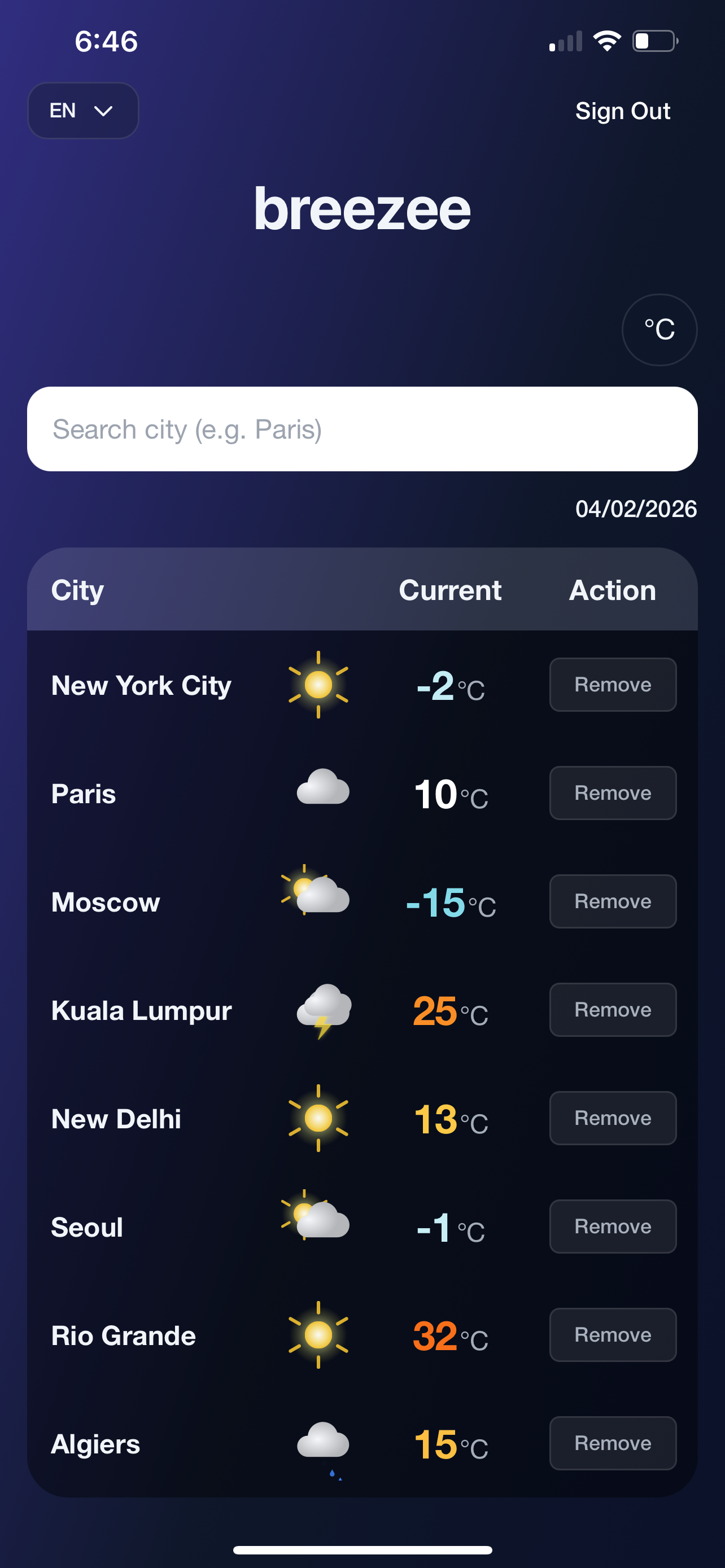
One of Breezee’s standout features is the ability to monitor multiple cities at the same time, including cities in Kosovo such as Pristina, Prizren, Peja, Gjakova, Gjilan, Ferizaj, and more.
With an intuitive interface and fast navigation, users can easily switch between cities, view real-time forecasts, and plan their activities without wasting time on unnecessary searches. The transition between locations is quick and effortless, making Breezee highly practical for everyday use.
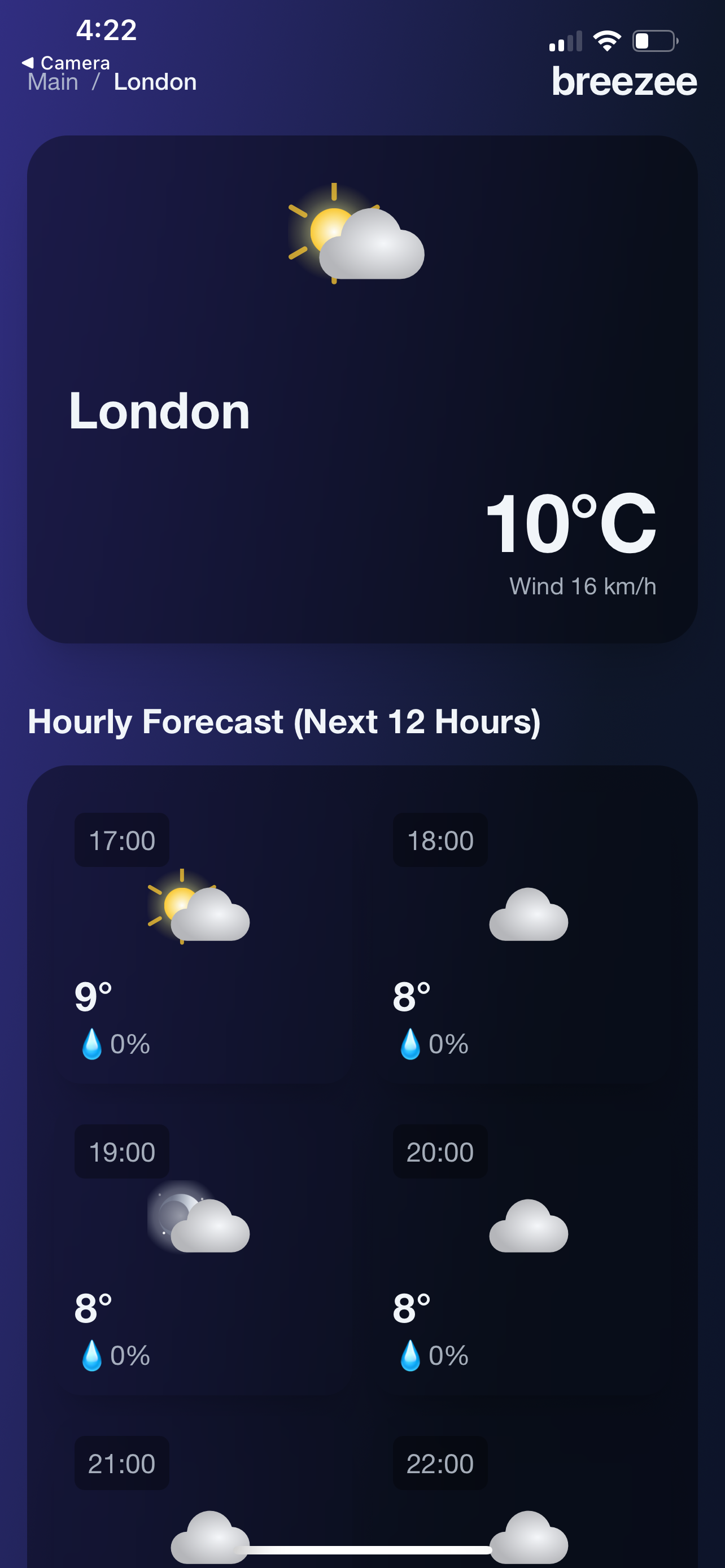
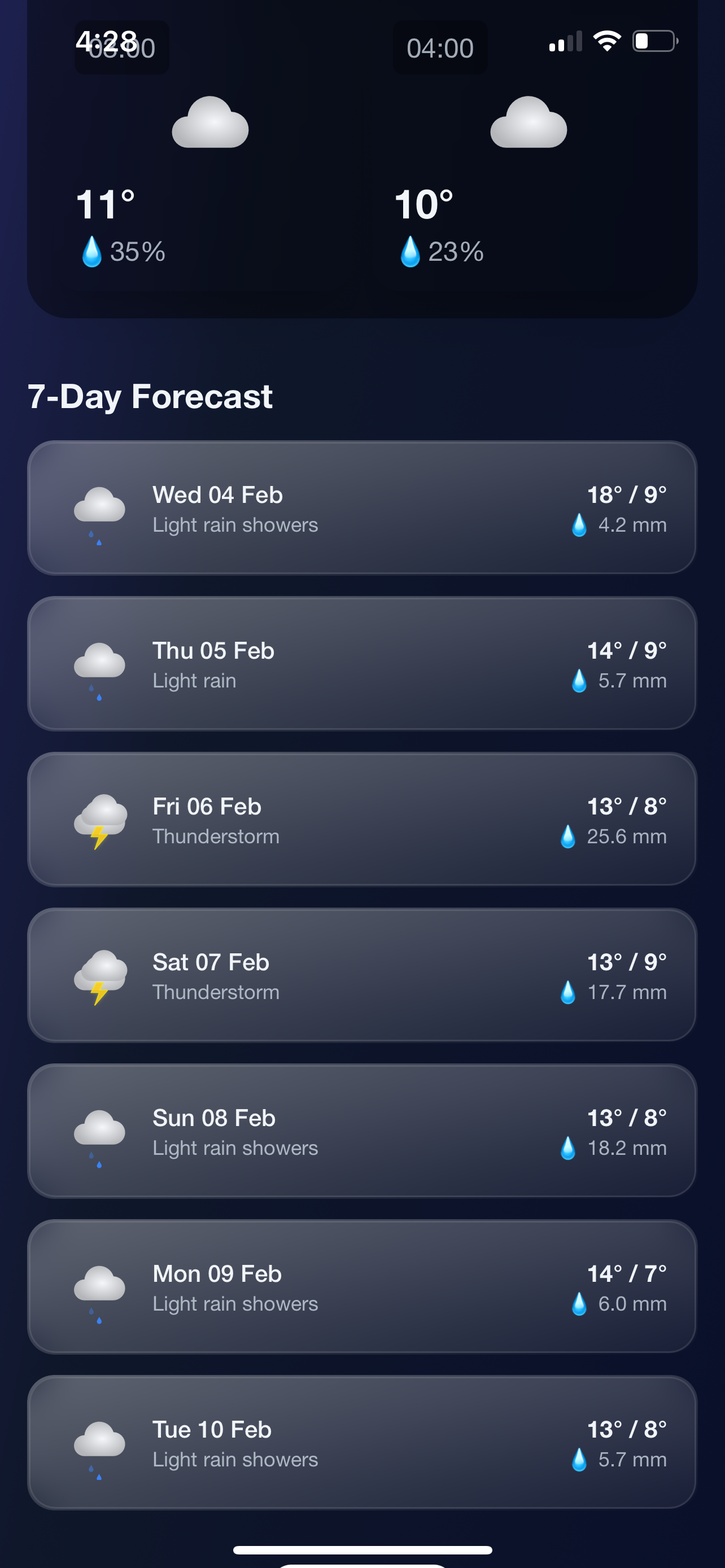
Breezee also offers a 7-day forecast with all the key elements. The information is presented in a simple, easy-to-read format, enough to plan your day or week effectively.
Multilingual support for a global experience
Built for a broad audience, the app supports multiple languages, making the experience accessible and personalized for every user. Whether used in Albanian, English, or other languages, the interface remains clear, intuitive, and easy to navigate — ensuring weather information is understood quickly and without confusion.
Performance and stability
The app is fast and reliable. Searches are instant, and weather updates are accurate and timely. Breezee feels lightweight and performs well even under weaker network conditions.
The audio experience within the app is designed to add depth to usage, combining soft sounds and subtle musical elements to create a calm, modern atmosphere. The result is a more immersive experience that makes the app not only functional but also aesthetically pleasing.
Final verdict
With its minimalist approach and strong focus on functionality, Breezee delivers a fast and stable experience, making weather tracking simple and enjoyable. If you’re looking for an app that combines modern design with practical features, Breezee is one of the best choices available today.
The app is available on both major mobile platforms: iOS users can download it from the App Store, while Android users can easily get it from Google Play, making it accessible to everyone regardless of device.
Clean design and practical functionality
From the very first launch, Breezee delivers a minimalist and refined feel. There are no unnecessary elements or cluttered interfaces, only clear and well-organized data. The visual experience gives it a premium look, making it intuitive and enjoyable to use.
Animations are subtle and smooth, while switching between cities is fast and seamless. The core focus remains clarity a deliberate choice that sets it apart from many other apps.
Managing multiple cities — one of its strongest features
One of Breezee’s standout features is the ability to monitor multiple cities at the same time, including cities in Kosovo such as Pristina, Prizren, Peja, Gjakova, Gjilan, Ferizaj, and more.
With an intuitive interface and fast navigation, users can easily switch between cities, view real-time forecasts, and plan their activities without wasting time on unnecessary searches. The transition between locations is quick and effortless, making Breezee highly practical for everyday use.
Breezee also offers a 7-day forecast with all the key elements. The information is presented in a simple, easy-to-read format, enough to plan your day or week effectively.
Multilingual support for a global experience
Built for a broad audience, the app supports multiple languages, making the experience accessible and personalized for every user. Whether used in Albanian, English, or other languages, the interface remains clear, intuitive, and easy to navigate — ensuring weather information is understood quickly and without confusion.
Performance and stability
The app is fast and reliable. Searches are instant, and weather updates are accurate and timely. Breezee feels lightweight and performs well even under weaker network conditions.
The audio experience within the app is designed to add depth to usage, combining soft sounds and subtle musical elements to create a calm, modern atmosphere. The result is a more immersive experience that makes the app not only functional but also aesthetically pleasing.
Final verdict
With its minimalist approach and strong focus on functionality, Breezee delivers a fast and stable experience, making weather tracking simple and enjoyable. If you’re looking for an app that combines modern design with practical features, Breezee is one of the best choices available today.
The app is available on both major mobile platforms: iOS users can download it from the App Store, while Android users can easily get it from Google Play, making it accessible to everyone regardless of device.